The Internet, as a globalized system of interconnected computers and networks, enables users to communicate and share information instantaneously, regardless of geographical location. Beyond its function as a communication tool, the Internet has profoundly transformed the relationship between art and its audience, and increasingly serves as a versatile medium for artistic creation, offering unprecedented functionalities and possibilities.
The Internet was initially conceived in the 1960s as ARPANET, a secure research network connecting academic and defense institutions across the United States. Over the following two decades, its infrastructure expanded to support broader scientific communication. In 1989, British scientist Tim Berners-Lee invented the World Wide Web (WWW), a service built upon the existing Internet protocol that allowed any connected computer user to access documents via hypertext links. This innovation rapidly accelerated the Internet's adoption, transforming it into a global platform for information retrieval and sharing, from academic research to online commerce and social networking. Culturally, the Internet has fostered a sense of a "global village," a concept first proposed by Canadian thinker Marshall McLuhan in 1962, well before the advent of the World Wide Web itself, underscoring its profound social and cultural impact.
As artist Robert Adrian observed, real-time global connectivity fundamentally challenges the notion of art as a largely independent, object-making activity. The simultaneous development of digital technology has enabled highly complex artworks to be disseminated to millions in online communities, transcending the limitations of traditional gallery spaces or physical publications. However, artists working in the internet domain face distinct challenges: without the established validation mechanisms of physical exhibitions or traditional critical discourse, discerning the artistic merit or authenticity of online artworks, whether commercial or experimental, can be difficult amidst the vast sea of digital content. Furthermore, the expectation of free content online often necessitates artists to seek alternative funding models. Online art also tends to be more ephemeral than traditional media, as long-term accessibility often requires continuous maintenance and updates.
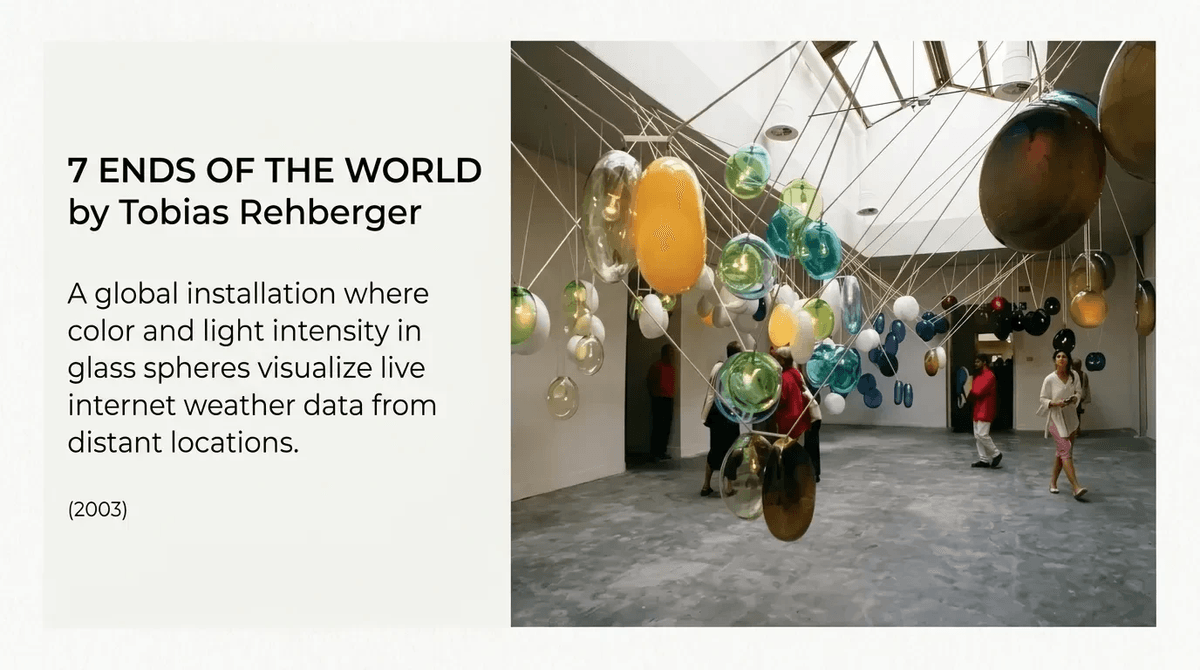
Despite these challenges, the Internet has infused new energy into art from the perspective of a globalized society and evolving political discourse. It has redefined the concept of "the world," shifting from segmented geographical maps to diverse and constantly changing networked contexts. This transformation is evident in data-driven works like Tobias Rehberger’s 7 Ends of the World (2003), an immersive installation where glass spheres visualize real-time stock market data through color and light intensity, creating a dynamic aesthetic experience. Other artists leverage the Internet to enhance interactive elements in their work; for instance, Claude Closky’s project Links (2000) presented an encyclopedic list of celebrity names, where clicking on any name led to that person’s commercial website, highlighting the commercialization of identity online. In the early 21st century, it became common for artists and art students worldwide to share and critique works via the Internet, fostering a new global artistic community.