Conceptual Art, at its core, emphasizes the realization of ideas over the production of physical objects. This foundational notion has been influential since the early 20th-century Dada movement. For later 20th-century Conceptual Art, this emphasis marked a decisive shift from purely craft-based approaches. Within the modern socio-economic system, by asserting the primacy of ideas over material objects, Conceptual Art offered a potent critique of art's perceived commodification.
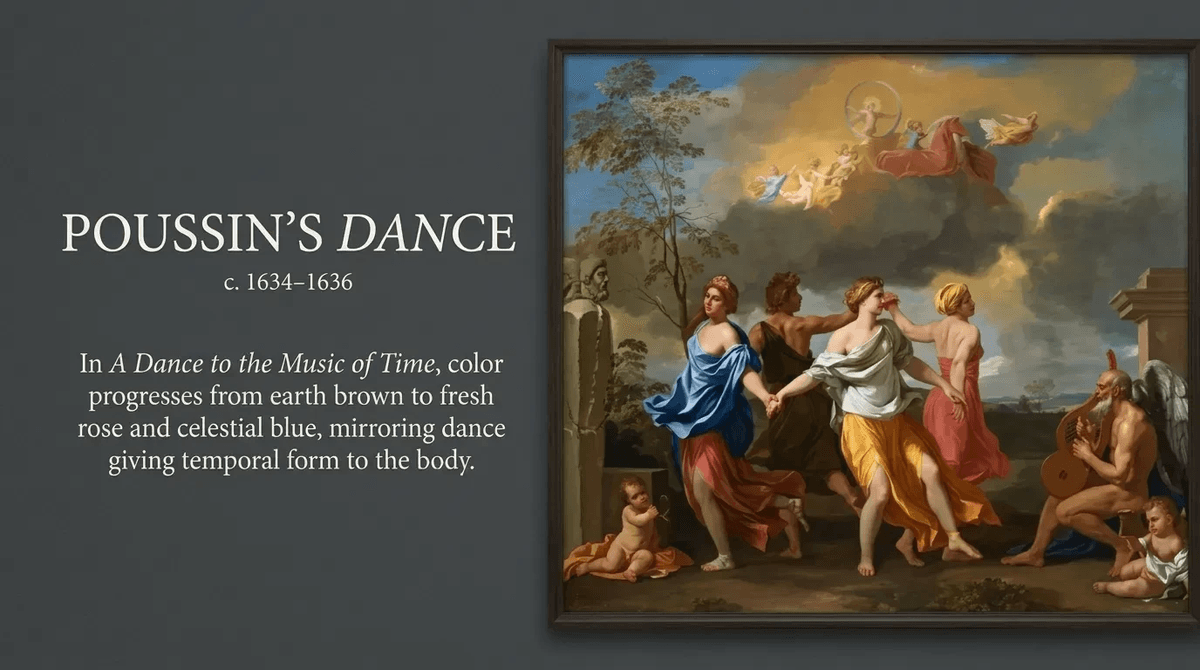
While the precise conceptual underpinnings of pre-modern art can be elusive, artists of the Italian Renaissance, such as Michelangelo, demonstrably valued the intellectual aspect of art—often referred to as disegno—as highly as its masterful execution. As Michelangelo is famously paraphrased, "True art is made by the intellect, not by the hand," highlighting the conceptual genesis of creative work. For Nicolas Poussin in the 17th century, the foundation of art lay in emphasizing the idea or disegno. Poussin himself stated that "those who are competent work with their minds, meaning they must first conceive what they intend to do," underscoring the necessity of intellectual conception prior to physical production. He viewed painters who merely imitated surfaces as relying only on intuition, dismissing such work as crude or vulgar. His allegorical painting A Dance to the Music of Time (1634–1636) embodies this maxim, where personified concepts (like Time) are expressed through the abstract principles of music to give physical form to dance.
Poussin's enduring emphasis on disegno over colorito continued to influence European art and art history for over two centuries. By the 19th century, however, while academic institutions clung to these principles, many avant-garde artists found such rigid rules increasingly irrelevant, leading to works that were often dismissed by the establishment as crude or vulgar. Figures like Sir Joshua Reynolds, for example, asserted that "the general idea is better than the particular," promoting idealization and generalization as the "glory" of human thought. William Blake famously countered, "To generalize is to be an idiot," emphasizing the unique and specific. This enduring debate over the primacy of idea or execution found later resonance in the 20th century. John Cage's "silent art" (such as 4'33") was not about mockery but about drawing attention to ambient sound and the act of listening, challenging the traditional definition of music and art, and inviting audiences to engage with the environment itself, shifting focus to conceptual presence over formal composition.
When Ad Reinhardt stated in the 1940s that "Art is art. Everything else is everything else," he articulated art's radical autonomy, asserting its intrinsic value rather than seeing it as a mere spectacle or commodity. From the 1960s onward, in contrast to such purist stances, a defining characteristic of much Conceptual Art was its explicit focus on the idea itself, often at the expense of the physical art object. Robert Morris's Statement of Esthetic Withdrawal (1963), for instance, was a notarized document that explicitly denied "all aesthetic qualities" to an earlier sculpture, redefining artistic value. Similarly, Joseph Kosuth's One and Three Chairs (1965) comprised not only a photograph of a chair and its dictionary definition but also a physical chair, meticulously exploring the conceptual relationships between object, image, and word, highlighting how meaning is constructed.
In the late 20th century, Conceptual Art gained significant favor as a contemporary medium in publicly funded museums and galleries. Through strategic marketing and educational programs, these institutions fostered a broader public engagement that ultimately prepared the ground for deeper appreciation and development of Conceptual Art. This broader public engagement not only transformed the audience's understanding of a work's conceptual content but also continually re-evaluated the very parameters of what constitutes art.