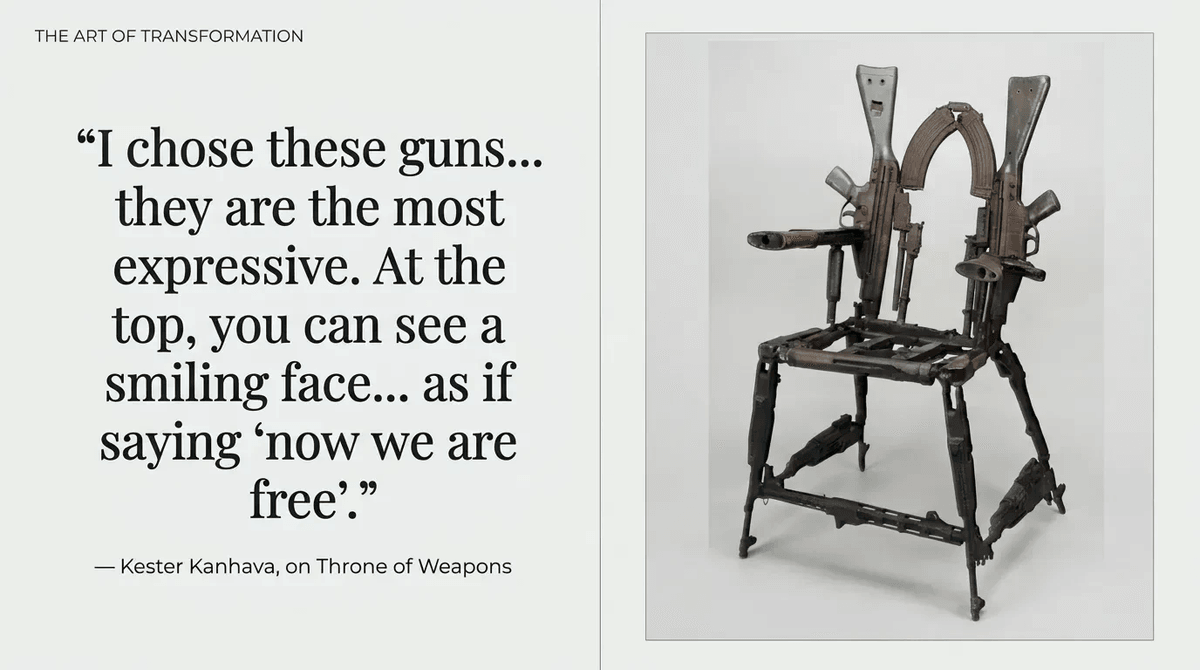
The defining characteristic of a found object—an objet trouvé—is its capacity to invest everyday things with new meaning. From urban debris to a bicycle saddle, or even decommissioned weapons, such commonplace items are incorporated into works of art with little or no modification. A found object might stand alone as an artwork in its own right, or it might be assimilated into an assemblage of several such items, shaped or colored to serve a deliberate design.
The human impulse to find and imbue ordinary objects with extraordinary significance can be traced back to antiquity. Early hominids, for instance, selected bones or stones, perhaps noting an accidental resemblance to a human or animal head and enhancing it with simple modifications. These chosen and adapted inanimate objects might represent some of humanity’s earliest expressions, valued not for utilitarian function but for their evocative power. This fundamental impulse, though often sublimated by the development of skilled craftsmanship and the artistic pursuit of creating illusions from raw materials, resurfaced profoundly with the modern concept of the found object. This strategy can elevate any artifact, however mundane or utilitarian its origin, into the realm of the special.
In the twentieth century, as the aura of the traditional masterpiece waned, the found object came into its own. In this climate, the most ordinary things—shards, refuse, debris—could be rescued and re-contextualized to yield entirely new meanings. The English Romantic poet William Wordsworth described a psychological equivalent to this process as "a plastic power," finding "an affinity / In objects where no brotherly affinity / Was common." For the poet, the physical object remains in situ while the mind performs its transformative work. For the visual artist, however, the object itself—whether a bicycle wheel or a ruler—must be physically detached from its original context and translated into the realm of art.
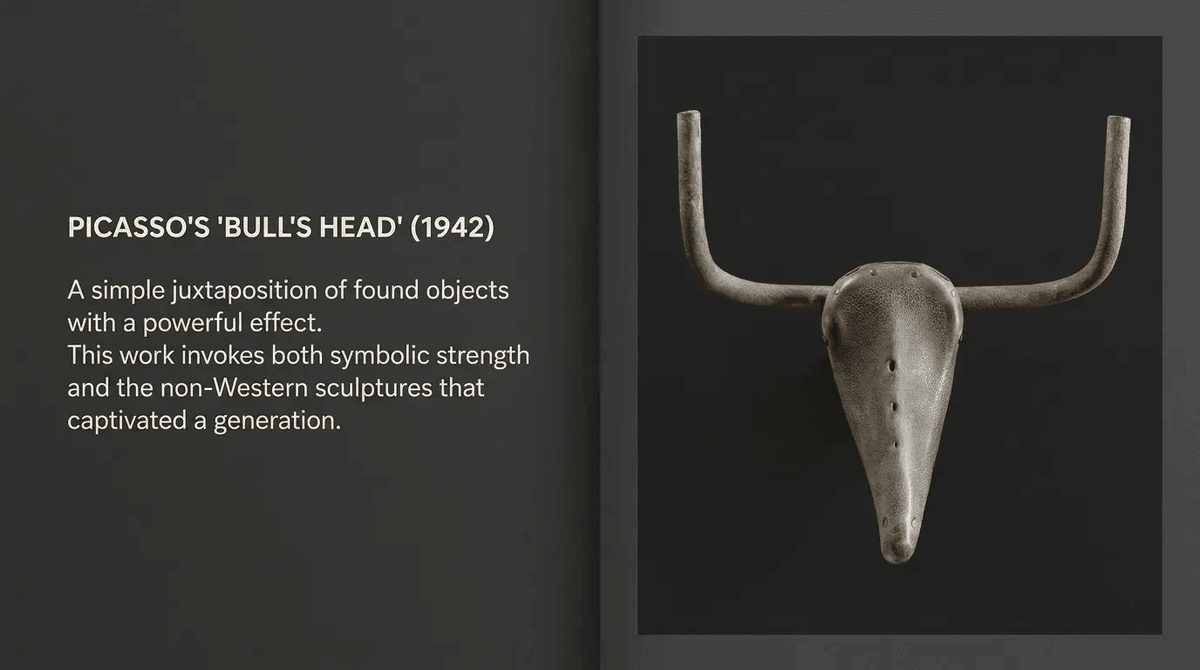
The found object provided rich material for Surrealism, exposing the uncanny side of the mundane material world while projecting the viewer's inner desires. The Exhibition of Surrealist Objects in Paris in 1936 was a modern equivalent of a Renaissance cabinet of curiosities, bringing together recent found objects, ready-mades, and ethnographic artifacts. The most memorable found-object sculptures of this or any period are often the simplest, such as Pablo Picasso's Bull's Head (1942) assembled from a bicycle saddle and handlebars. While investing the found objects with new meaning, the artist also introduces a powerful conceptual dimension.
Dadaism, and in particular Kurt Schwitters' concept of Merz, established the found object as a permanent fixture across many artistic genres. In the 1950s, Robert Rauschenberg's 'Combines' merged photographs with all manner of urban refuse, including a stuffed Angora goat. The artists of the Italian movement Arte Povera, such as Michelangelo Pistoletto, used found objects to bridge what they saw as the gap between art and life. In the 1980s, a generation of British sculptors made a specialty of reconfiguring discarded consumer durables, as seen in the work of Bill Woodrow and David Mach, or Tony Cragg's map of plastic debris, Britain Seen from the North (1981). Installation artists frequently employ found objects en masse, as in Cornelia Parker's use of charred wooden fragments in Cold Dark Matter: An Exploded View (1991).