Kinetic art—art that incorporates actual movement or relies on perceived motion—fundamentally alters the stable relationship between a static object and the viewer. It transcends purely physical representation, often translating abstract concepts like "exploring space" or "harmonious arrangement" into literal, dynamic movement. While modern kinetic art emerged in the 20th century as a distinct movement, the human fascination with mechanical movement and its artistic potential boasts a long history, with precedents in ancient mechanics. Marvels of technical skill and inventiveness, such as historical automata whose existence was often legendary, foreshadowed this interest. Even Giorgio Vasari recorded Leonardo da Vinci's constructions of mechanical birds and a mechanical lion with an awe similar to that inspired by Leonardo's paintings, highlighting a long-standing appreciation for engineered motion that laid conceptual groundwork.
In the Age of Enlightenment, the intricate relationship between art and science was symbolized by highly sophisticated automata, such as the flute-player and the digesting duck designed by Jacques de Vaucanson (who later applied his skills to inventing an automated loom). These creations embodied the era's conception of living things in a universe viewed as a vast piece of clockwork, set into motion by a divine clockmaker, bridging the gap between mechanical ingenuity and life-like representation.
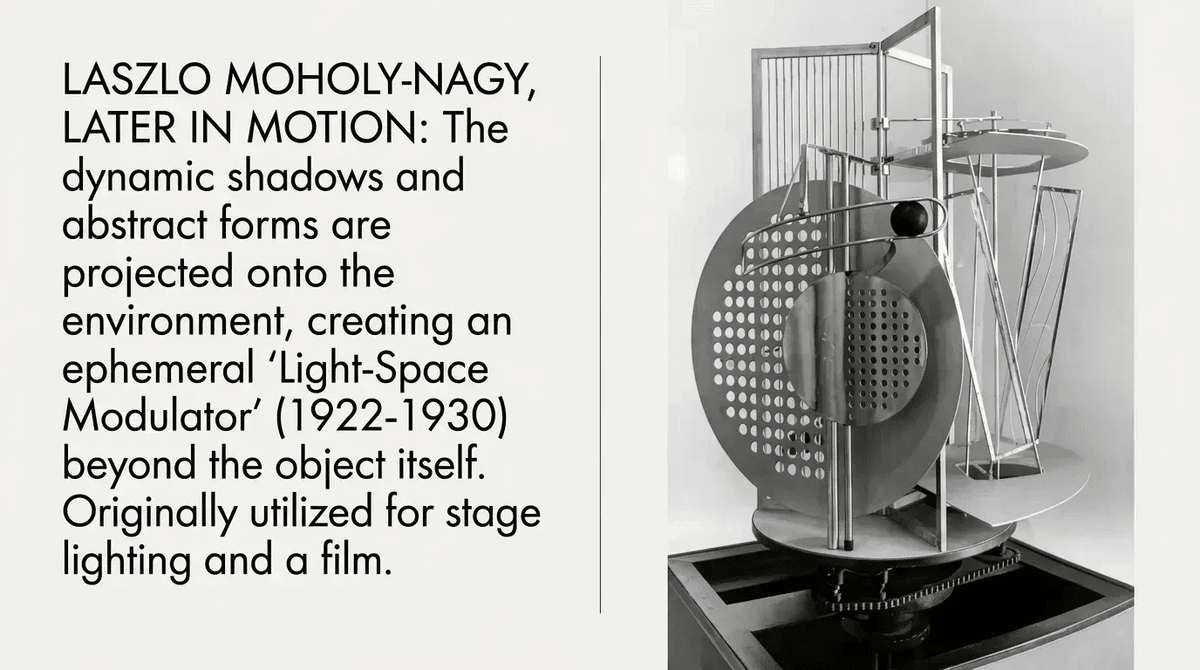
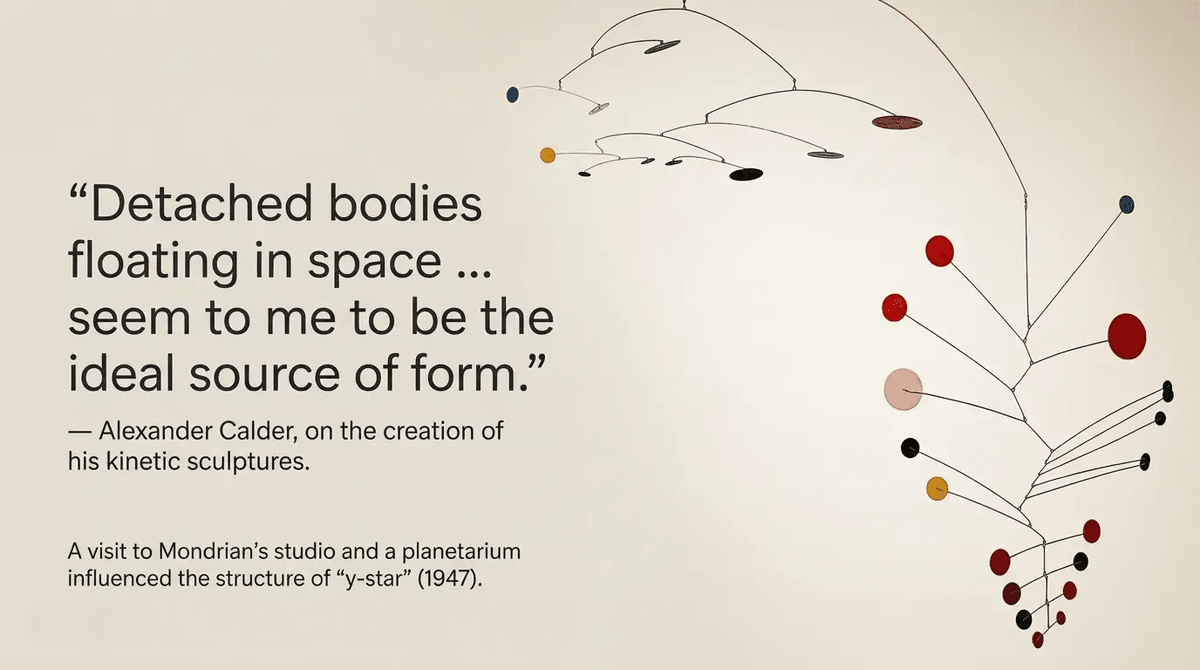
In the early twentieth century, artists began to consciously integrate motion into their artistic theories. Naum Gabo, a key figure in Constructivism, articulated art as an activity intrinsically concerned with the wider social sphere, where objects 'with their own rhythms form the universe.' He famously claimed that 'space and time are the forms on which life is built and hence art must be constructed,' a powerful manifesto for kinetic art. Rejecting both the 'closures' of Impressionism and the 'new delusions' of Cubism, Gabo declared that 'kinetic rhythms are the basic forms of our perception of real time.' His Kinetic Construction (Standing Wave) (1919–20) exemplified this, utilizing a single strip of metal whose rapid vibration generated a ghostly three-dimensional volume. Simultaneously, László Moholy-Nagy’s Light-Space Modulator (1922–30) became a quintessential machine-age automaton, exploring light, space, and motion. Alexander Calder’s mobiles, drawing on a somewhat different trajectory—famously influenced by a visit to Mondrian’s studio—introduced colored discs designed to hang and drift on currents of wind. These works brought a casualness of unconscious gestures to organized movement, a dream-like rhythm recognized by Surrealists as an authentic mode of artistic expression.
These foundational approaches to kineticism by artists like Gabo, Moholy-Nagy, and Calder offered rich conceptual and material resources for subsequent artists. Later kinetic artists continued to interpret the relationship between art and its environment in distinct ways. Jean Tinguely’s mechanical sculptures, which often caper whimsically in public spaces (such as outside the Centre Pompidou in Paris), combine Calder’s Surrealist playfulness with the intricate mechanisms of Vaucanson’s automata. Liliane Lijn’s Liquid Reflections (1966–68) presents a beauty of physical precision through the interplay of light and moving fluid. Lijn described her work as a form of "drawing," noting, 'it has the same rhythm, the same giant energy,' highlighting the fluid, dynamic nature of her visual creations.