In satire, the deliberate distortion of figures serves as a critical weapon aimed at exposing societal or individual flaws. On one level, the appeal of visual satire is visceral, often provoking immediate emotional responses. On another, it demands a sharp-eyed complicity from the viewer, who must simultaneously be prepared to mock and condemn the subject.
Art has historically operated within boundaries of taste defined and approved by its consumers. In satire, however, the artist assumes the role of a moral agent, explicitly exposing the chasm between "what is" and "what ought to be." The wider and more egregious this gap, the more savage and cutting the satirical response. Satire is often stylistically conservative, prioritizing clarity to ensure its meaning is readily understood. William Hogarth’s sharp critiques of eighteenth-century English society, for instance, relied on literal narratives that most contemporary viewers could comprehend. Ultimately, satirical strategies inherently subvert the conventional expectation that art is meant to flatter or soothe, instead embracing confrontation and provocation.
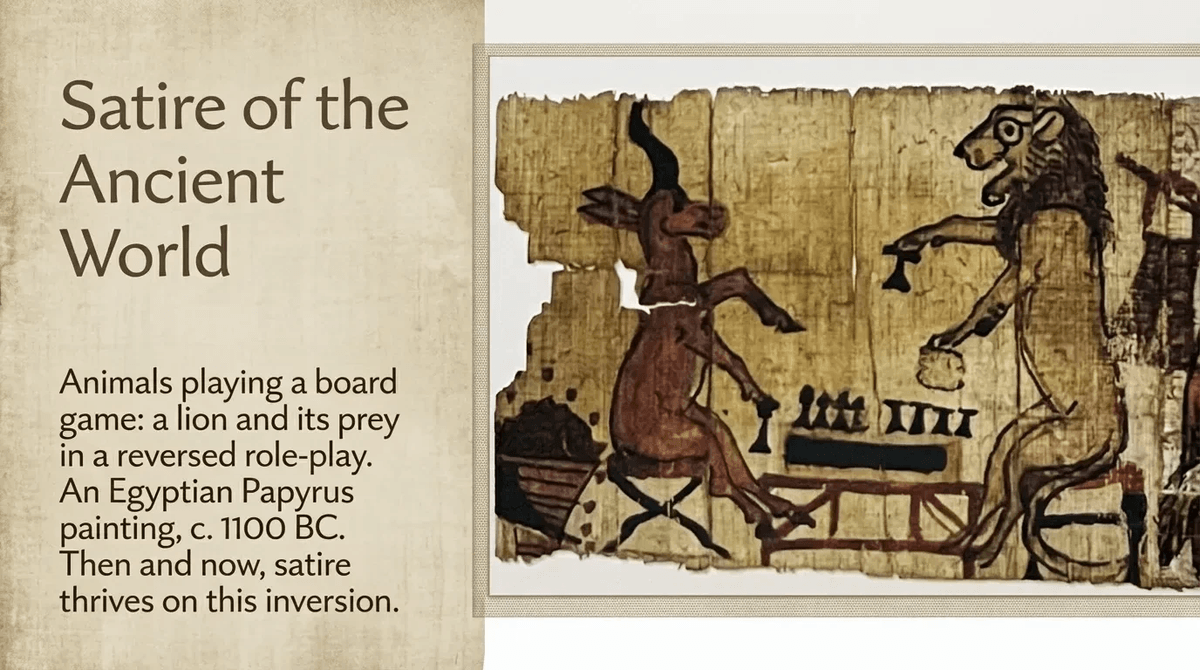
Since antiquity, artists have frequently employed animals in human roles to satirize human weaknesses. Animals, often perceived as embodying natural instincts or archetypes, offer a detached yet insightful means to allegorize human folly and hypocrisy. The Ancient Egyptian papyrus detail below, for example, illustrates this tradition. While the precise contextual nuances of its creation may be debated by scholars, its allegorical power, depicting a lion and its prey engaged in a reversed role-play, remains potent. This inversion highlights how the pressure of social conformity, alongside injustice, violence, and oppression, invariably seeks an outlet through such potent visual commentary.
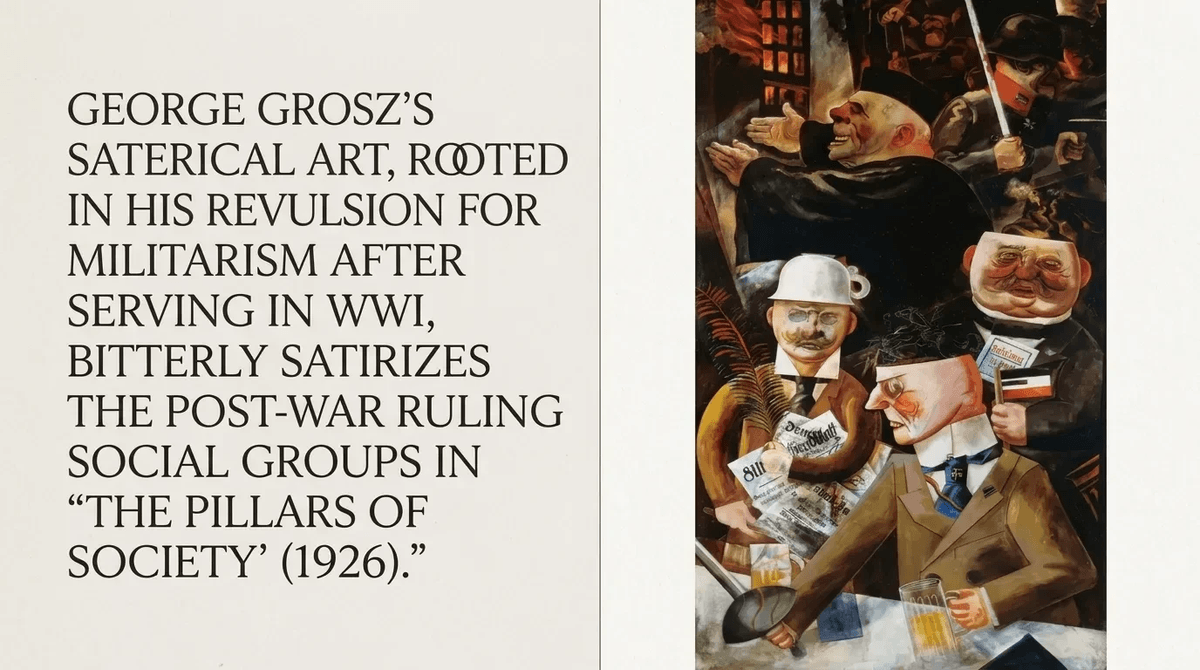
The French painter and caricaturist Honoré Daumier, for example, was famously imprisoned for six months for a print satirizing King Louis-Philippe, depicting him as literally "feeding" his supporters with wealth squeezed from his subjects. Visualizing a verbal insult or abstract concept is a potent satirical weapon, often deriving its strength from literally interpreting a metaphor. In George Grosz’s The Pillars of Society, the bloated figures of Weimar Germany’s elite—corrupt politicians, militarists, and clergy—are literally depicted with steaming dung or offal in their heads, symbolizing their moral depravity. Like the plays of Bertolt Brecht, Grosz’s satire is both specific in its targets and universal in its depiction of the corruption and decay that fester beneath the surface of social respectability.
Satire is fundamentally active and provocative, implying an alternative state of affairs. Francisco de Goya’s print series Los Caprichos (1799) powerfully combined fantastic, satirical imagery with a semi-documentary realism to expose the dark side of late eighteenth-century Spanish society. Satirical "truth" is inherently partisan, not objective, and relies heavily on a shared understanding with its target audience. Satire is, therefore, inherently aggressive, aiming to disrupt and challenge rather than merely to entertain.