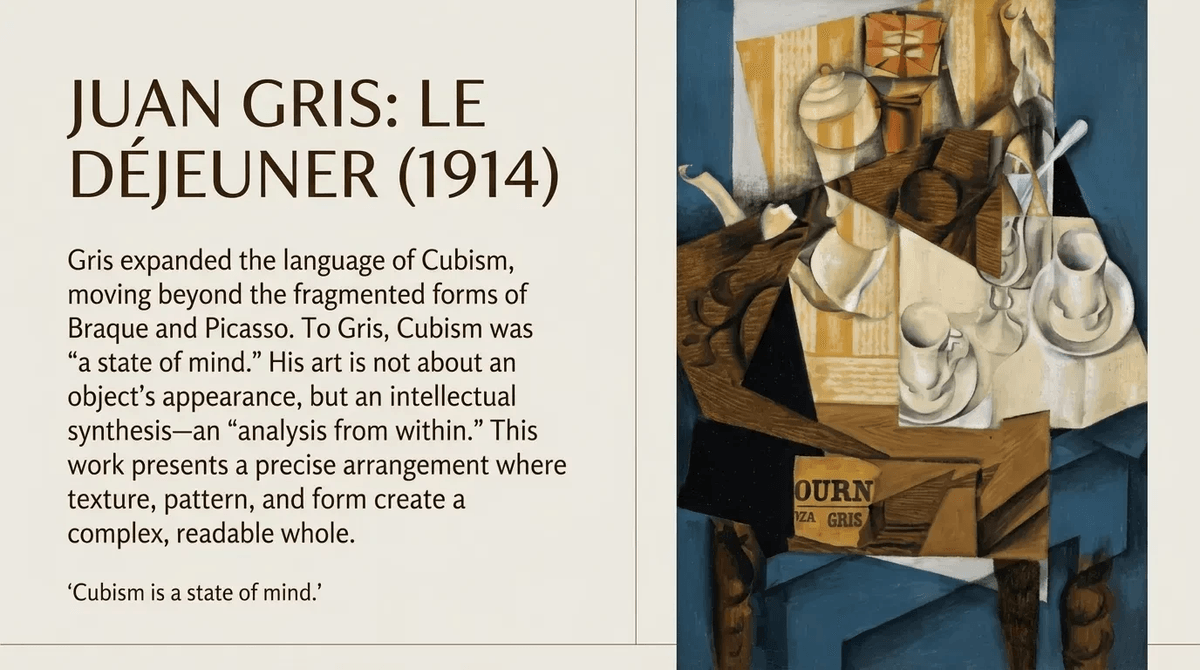
During the first decade of the twentieth century, two young artists in Paris, Georges Braque and Pablo Picasso, launched a radical break with a 500-year-old tradition in Western painting: the single, fixed viewpoint. Their invention of Cubism represented the ultimate formal expression of the multiple viewpoint, fundamentally challenging how reality was depicted.
Single-point perspective, developed in the fifteenth century, had governed artistic representation by establishing a fixed spatial relationship between the spectator and the picture, as well as among the illusionistic elements within the painting's virtual space. It was a highly successful convention, dictating how a picture was seen rather than how the world is actually perceived. It treated the painting as a static "window" through which the viewer gazed at an unchanging scene. Yet, over centuries, it remained largely unquestioned, despite the reality that visual experience consists of a succession of fleeting glances, shifting focus, and constant reframing as we navigate a street or observe a tabletop.
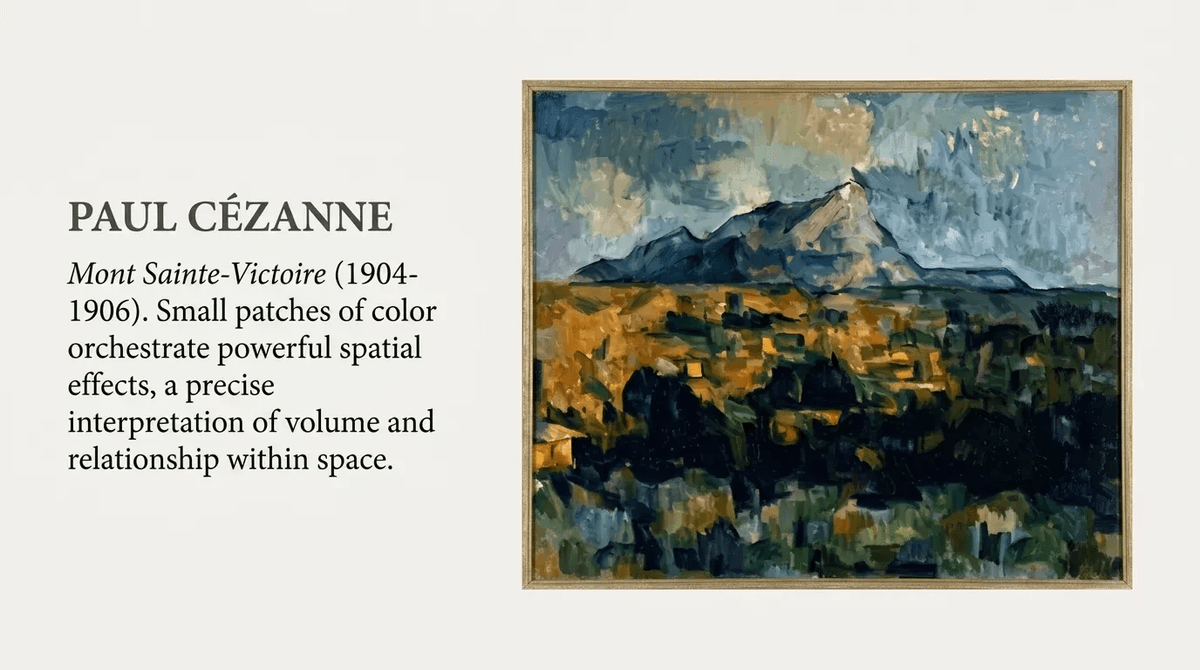
By 1900, photographic technology was already subverting this "window-like" relationship between the image and the world. Innovations like multiple-exposure photography and scientific motion studies showcased different facets of an object, or successive phases of an action, simultaneously. These advancements made it evident that looking is not a passive stare but an active, cumulative process. Avant-garde painters were already responding to these insights. Paul Cézanne, for example, profoundly influenced Cubism by emphasizing the physical reality of the brushstroke, color patch, and line, prioritizing their optical effect over the mere imitation of three-dimensional illusion.
Braque and Picasso’s radical alternative involved constructing a form of painting that was both traditionally painterly and intellectually challenging. Picasso famously stated: "I paint objects as I think them, not as I see them." Instead of illusionistic depth, they employed overlapping, fragmented planes of shifting tone, defined by simple lines and shallow arcs, much like reflections in a shattered mirror. In Braque’s The Portuguese (1911), fragments of seemingly unrelated elements—a stenciled sign, a guitar string, a rope—are anchored around a central figure, inviting the spectator to mentally reconstruct the subject. This approach characterized Analytical Cubism, which later evolved into Synthetic Cubism’s collage technique. While early Cubist paintings employed geometric concepts, Braque and Picasso’s still lifes and portraits were based on the fluctuating relationship between the object and the picture plane, similar to Cézanne’s landscapes, rather than rigid mathematical formulas. As Picasso aptly remarked, "Cubism is no different from any other school of painting... It is like a perfume, in front of you, behind you, to the sides, you don’t know where it comes from."
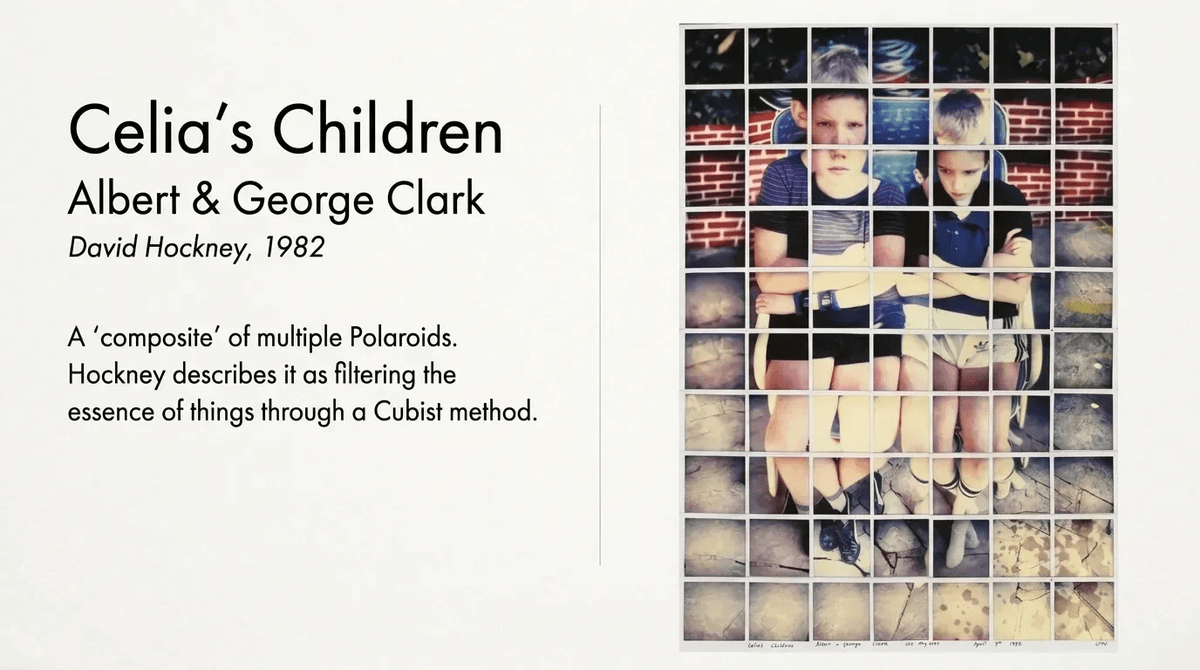
The simultaneous presentation of multiple viewpoints became Cubism’s defining and most influential feature. Although few later artists adopted this literally in painting, David Hockney’s photo-collages of the 1980s successfully translated this principle into photography. These works constructed images of a single subject by assembling multiple photographs taken from different angles, creating a fragmented yet comprehensive view.