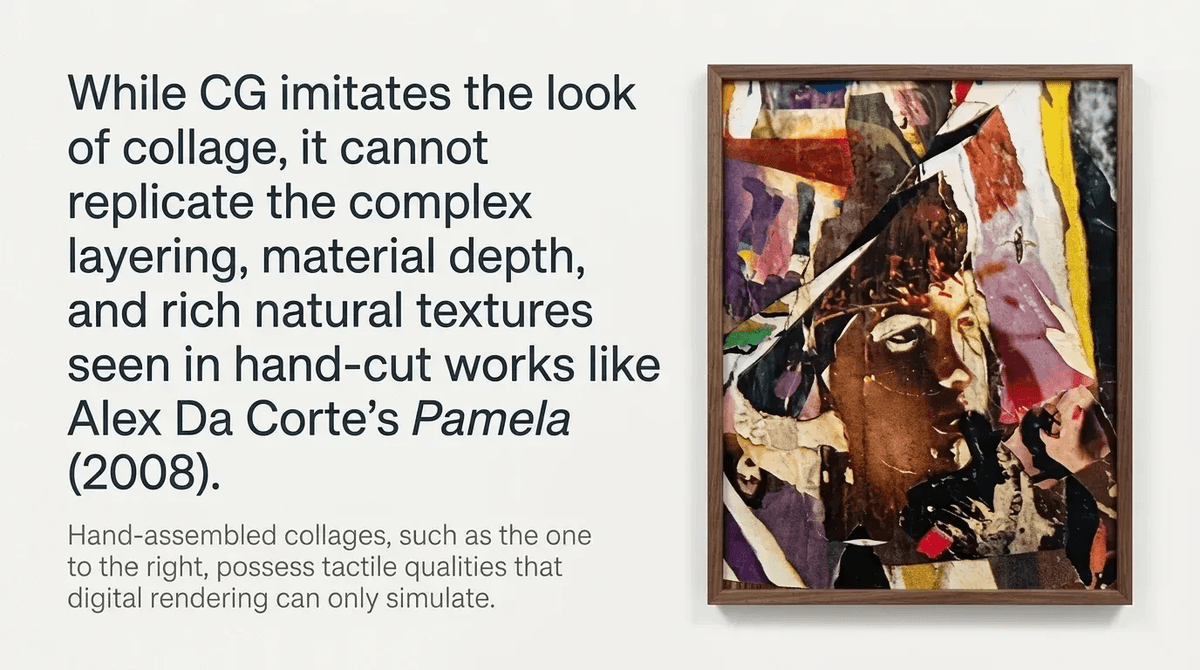
The word "collage" derives from the French coller, meaning "to glue." As a fine-art technique, it entails selecting fragments of pre-existing materials—such as newspaper, patterned paper, or fabric—and pasting them onto a flat support to form a new, composite image. This process allowed artists to reassemble ready-made materials into an entirely novel pictorial composition.
Before Cubist artists adopted it, the pasting of cut-out pictures was a popular parlor pastime, used in scrapbooks, keepsakes, crafts, and postcard albums. However, in 1912, Pablo Picasso and Georges Braque fundamentally transformed collage from a domestic hobby into a powerful tool for avant-garde artistic creation. Their pioneering experiments rapidly disseminated throughout the European avant-garde, subsequently fostering the development of photomontage, assemblage, and other three-dimensional formats.
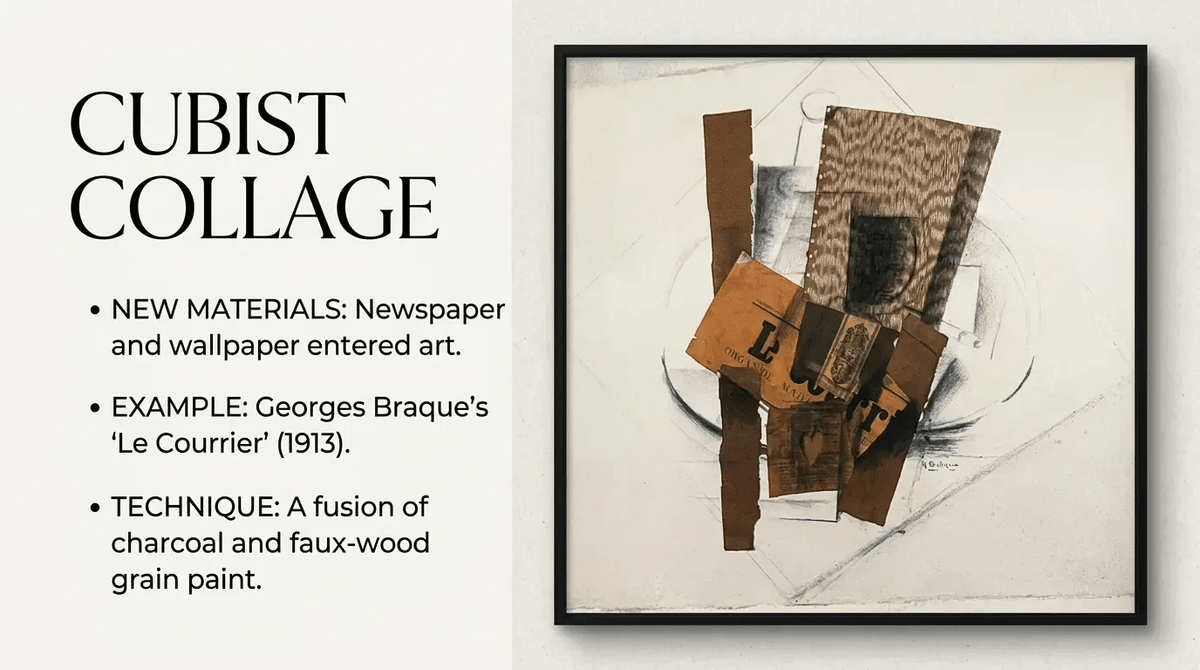
The conceptual underpinning of collage was deeply consistent with Braque’s and Picasso’s earlier ideas about the reconstruction of painting. It offered a decisive resolution to a long-developing argument. As the painter and theorist Maurice Denis famously observed in 1890, a picture—before being a warhorse, a nude, or some anecdote—is fundamentally "a flat surface covered with colors assembled in a certain order." Collage pushed this insight further: it was no longer merely the painted representation of real things, but real things themselves that constituted the picture. "Why paint a representation of a newspaper," the argument went, "when you can stick a real piece of newspaper onto the support?"
Picasso’s Still Life with Chair Caning (1912) is widely cited as the first true collage. This modest-sized work held the same conceptual weight as a painting, challenging traditional hierarchies. On an oval canvas support, Picasso pasted a piece of oilcloth printed with a chair-caning pattern, along with fragments of newspaper, a pipe, and a lemon slice. To complete the work, he framed the oval canvas with carved wooden frames traditionally used for paintings, ironically juxtaposing the new with the old. The previous year, Braque had introduced machine-printed wood-grain paper into his drawings, soon applying it to collages, which he termed papiers collés (pasted papers).
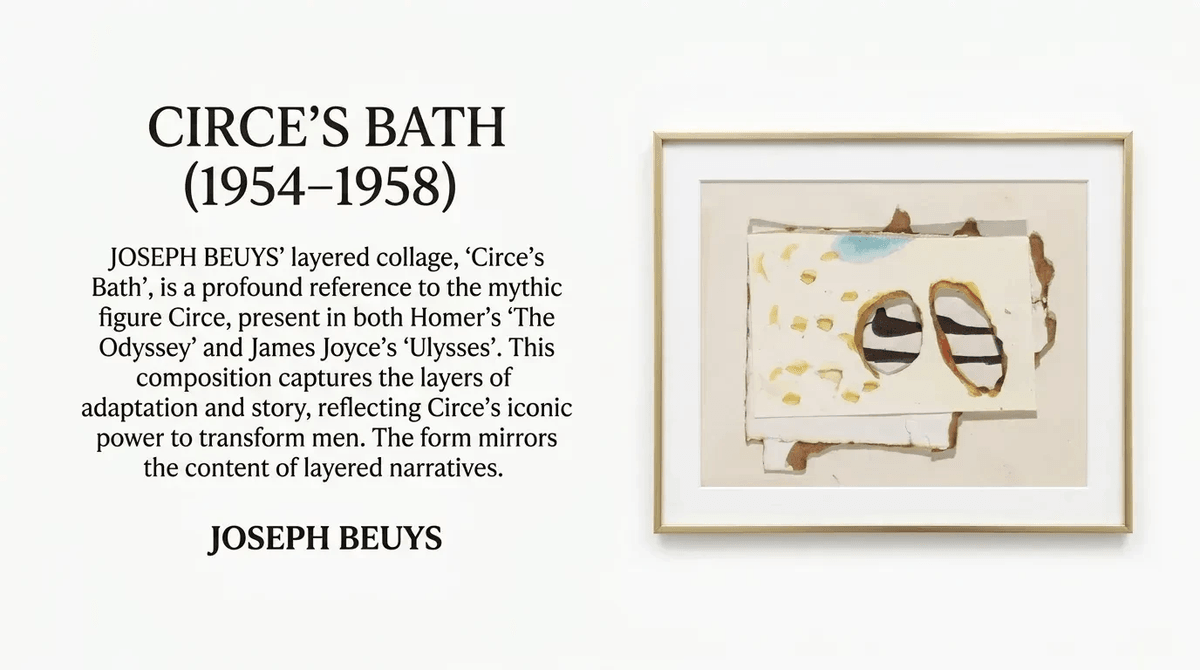
Cubist collages typically eschewed bright colors, preferring a muted palette of browns and grays derived from newspapers, tobacco wrappers, and sheet music. Later, Henri Matisse reimagined collage as a medium for exploring the interaction of pure color and shape. In his late career, his gouaches découpées (paper cut-outs) began as a temporary layout method but eventually became his primary medium for creating large-scale, semi-abstract compositions. For artists like Matisse, collage was indeed a way to "draw with scissors," enabling a direct, intuitive engagement with form and color.
In the late twentieth century, many artists focused more on the material texture of collage than on its graphic design. Alberto Burri’s Sacchi (Sacks), for instance, comprised rough pieces of burlap stitched together to convey a raw, tactile abstraction. In the United States, Robert Rauschenberg famously incorporated collage into his ‘Combines,’ utilizing a mix of found objects and painted elements to reflect the complex, layered visual culture of contemporary life, asserting the material presence of everyday detritus in art.