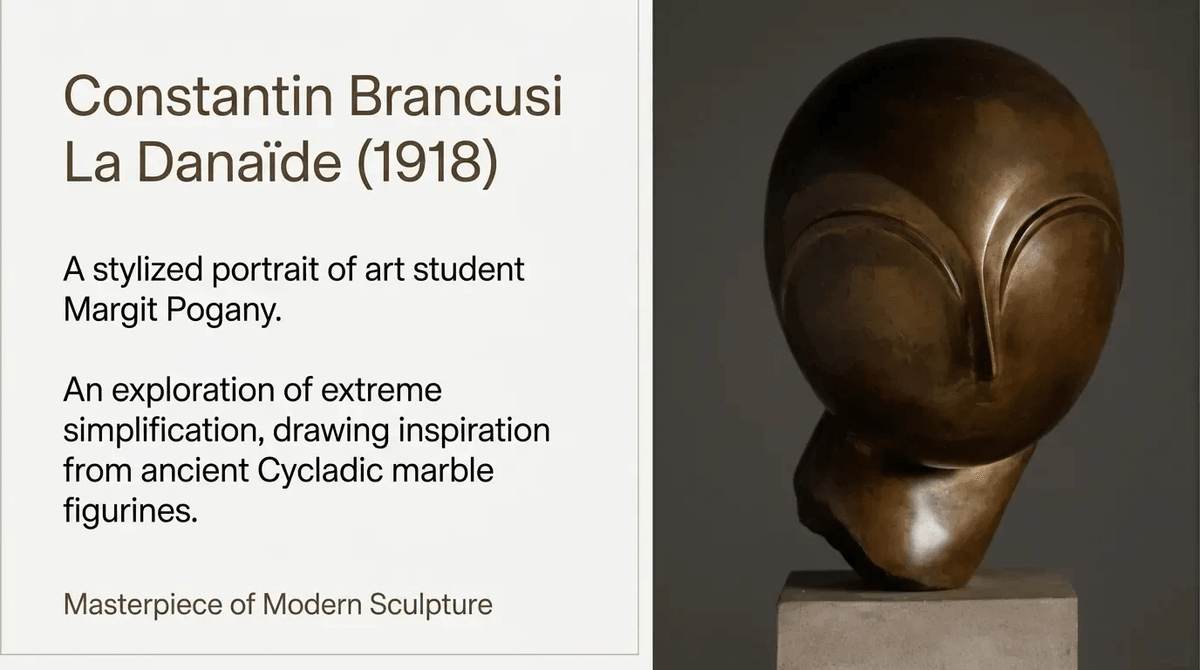
The concept of "the primitive" carries a complex and often morally charged history within Western art, deeply influencing artists from the Renaissance onwards. Initially, it fueled a nostalgic view of earlier societies, perceived as possessing a vitality that modern Western society had supposedly lost. For instance, Giorgio Vasari, in his Lives, speculated that the first artists, akin to children in a primeval society, began drawing instinctively. This notion of "the primitive" was thus adopted in Western art both as an imagined origin point and as a potential future. However, this artistic engagement often intertwined with the colonial era's gaze, which simultaneously romanticized and subjugated non-Western cultures.
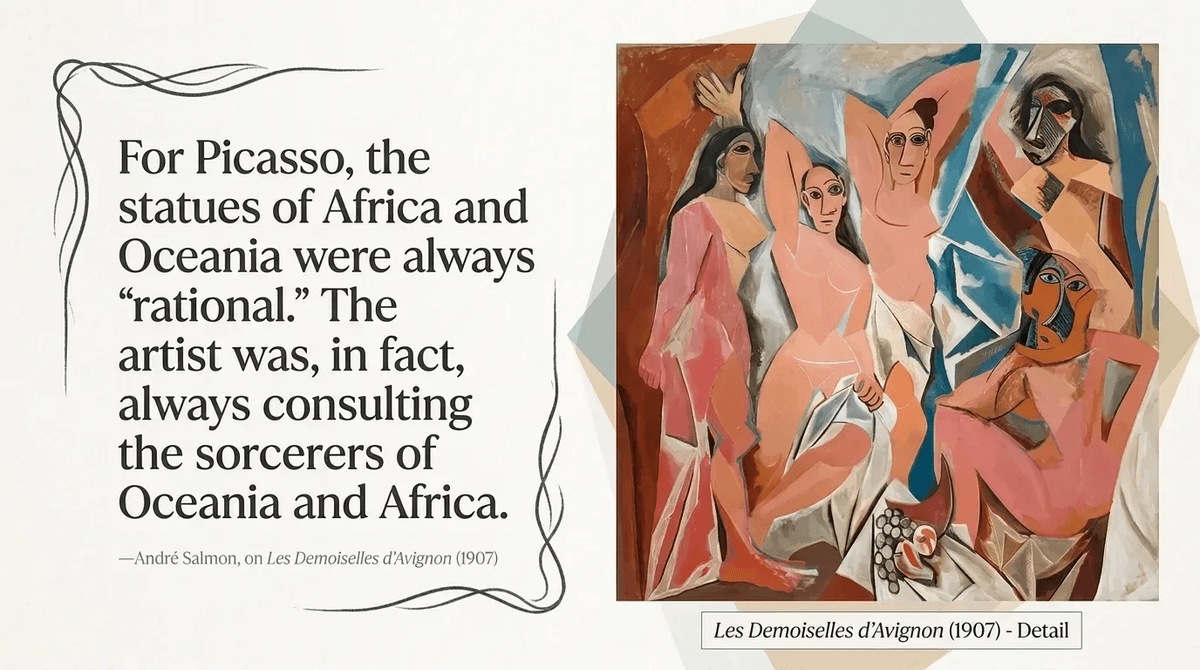
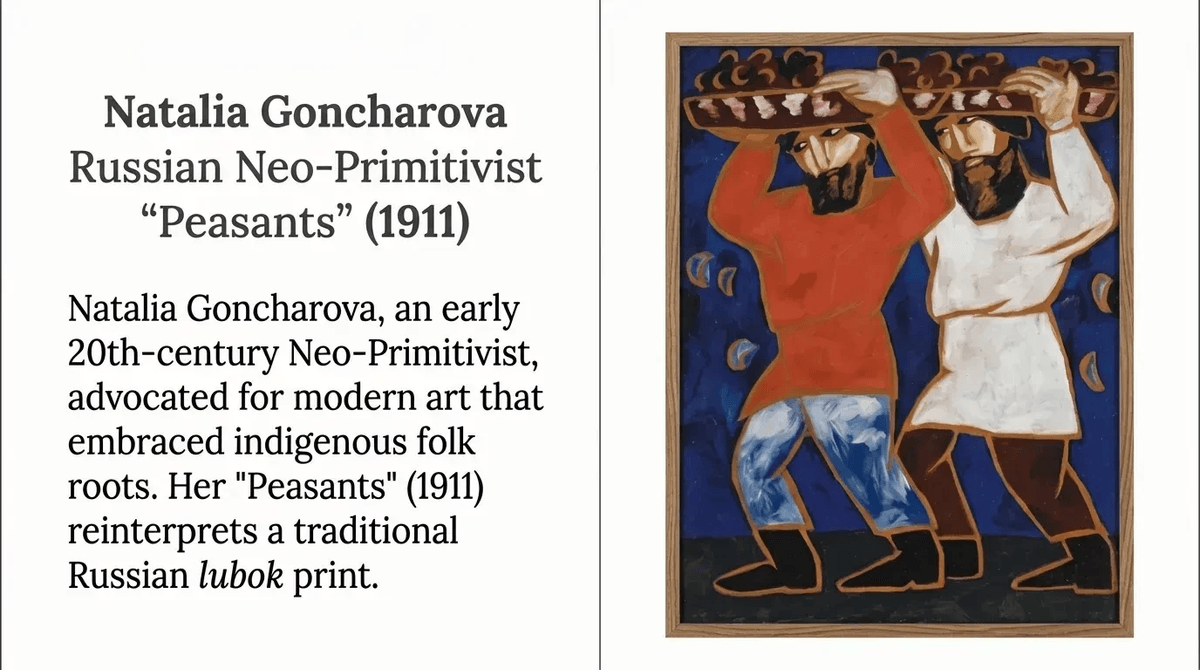
From the eighteenth century, the belief in human progress—the idea that human knowledge and capabilities are constantly improving—dominated European thought. The counterpart to progress, the concept of the ‘primitive,’ became an attractive counter-thesis. Educated Europeans saw ‘primitive’ culture—which included the rural folk culture of their own countries as well as of colonized territories—as representing an earlier stage of human development and in need of pacification, or as unspoilt and, to Western eyes, spiritually refreshing. This contradictory concept was highly stimulating to progressive artists of the early twentieth century.
In 1920, the British critic Roger Fry noted the profound influence and 'exquisite skill of the African wood-carver,' arguing it surpassed much of what his own generation had produced. This was a startling assertion in a European art world that had spent centuries mastering the illusionistic representation of the human form. Picasso’s Les Demoiselles d’Avignon (1907) famously shattered this tradition, directly incorporating elements inspired by African and Iberian art. Similarly, Constantin Brancusi’s radically simplified heads and birds evoked ancient, abstract forms, drawing inspiration not only from non-Western art but also from the folk traditions of his native Romania. This search for an alternative to the industrial present also found expression in domestic parallels; in Britain, Ben Nicholson was captivated by the paintings of the elderly, self-taught fisherman Alfred Wallis, while in France, Picasso honored Henri Rousseau, a retired customs official celebrated for his uncanny jungle scenes.
After the Second World War, the fascination with 'the primitive' underwent a significant shift. Jean Dubuffet coined the term Art Brut (raw art) to describe the art of children, the mentally ill, and other self-taught creators, offering a different lens through which to explore raw artistic truth. In his own work and that of his contemporaries, crude figures and deliberately unrefined techniques reimagined aesthetic norms. In the late twentieth century, postcolonial critiques of power relationships—between colonizer and colonized, adult and child, master and servant—increasingly rendered the romanticized concept of the 'primitive' untenable. Nostalgia for a pristine primeval past was largely replaced by an interest in vernacular or popular art forms, such as street art, acknowledging their authentic cultural roots rather than projecting idealized Western fantasies onto them.