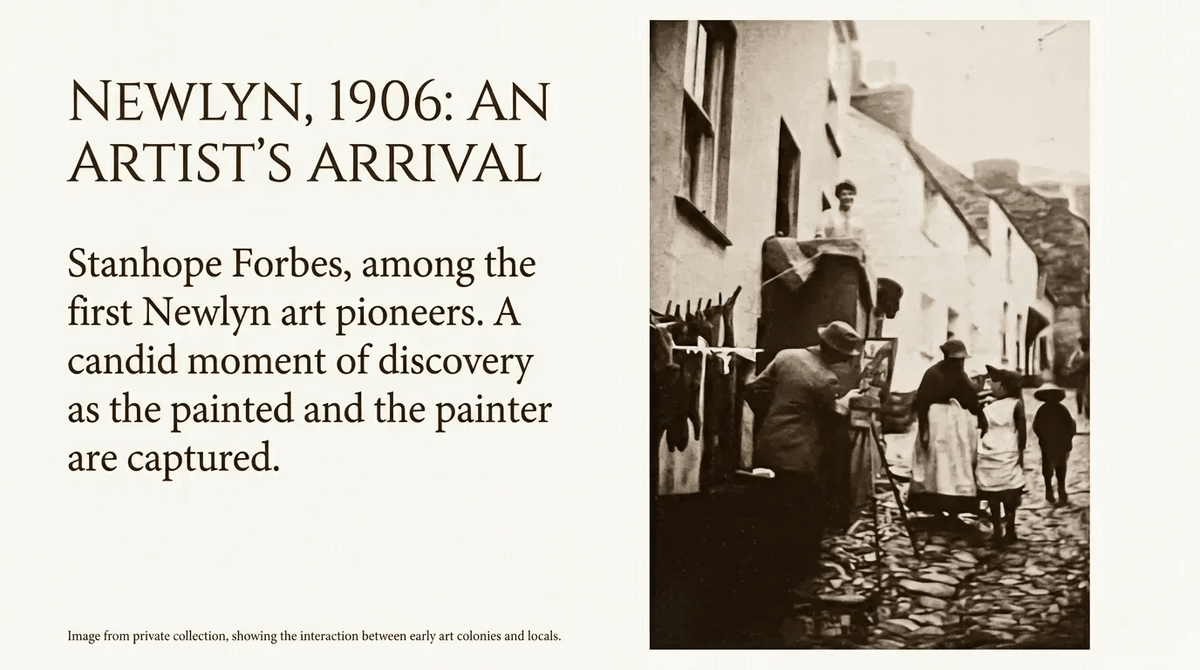
During the late nineteenth and early twentieth centuries, artists' colonies emerged as a distinct socio-artistic phenomenon, particularly in Northern Europe. These communities expressed a desire to escape the perceived complexities and constraints of urban life, seeking a simpler, often utopian, rural existence. Here, artists aimed to live harmoniously with their environment and cultivate a more authentic creative life, consciously rejecting the mass-produced patterns of modern industrial society.
The establishment of these artistic enclaves often had socio-cultural parallels with the broader trends of internal migration and cultural exchange of the era. Motives were primarily driven by aesthetic and philosophical pursuits rather than political expansion. Locations like Worpswede near Bremen, Pont-Aven and Concarneau in Brittany, Cape Breton Island in Canada, Newlyn and St Ives in Cornwall, and Abramtsevo in Russia, among many others, became hubs for this movement. Urban painters arrived, initially as visitors and then as permanent residents, often converting abandoned industrial buildings or barns into studios and working en plein air. These newcomers frequently engaged with the local populace, depicting them in their distinctive settings – returning from fields, fishing, or dressed in traditional attire – thereby creating a visual record of vanishing rural lifestyles.
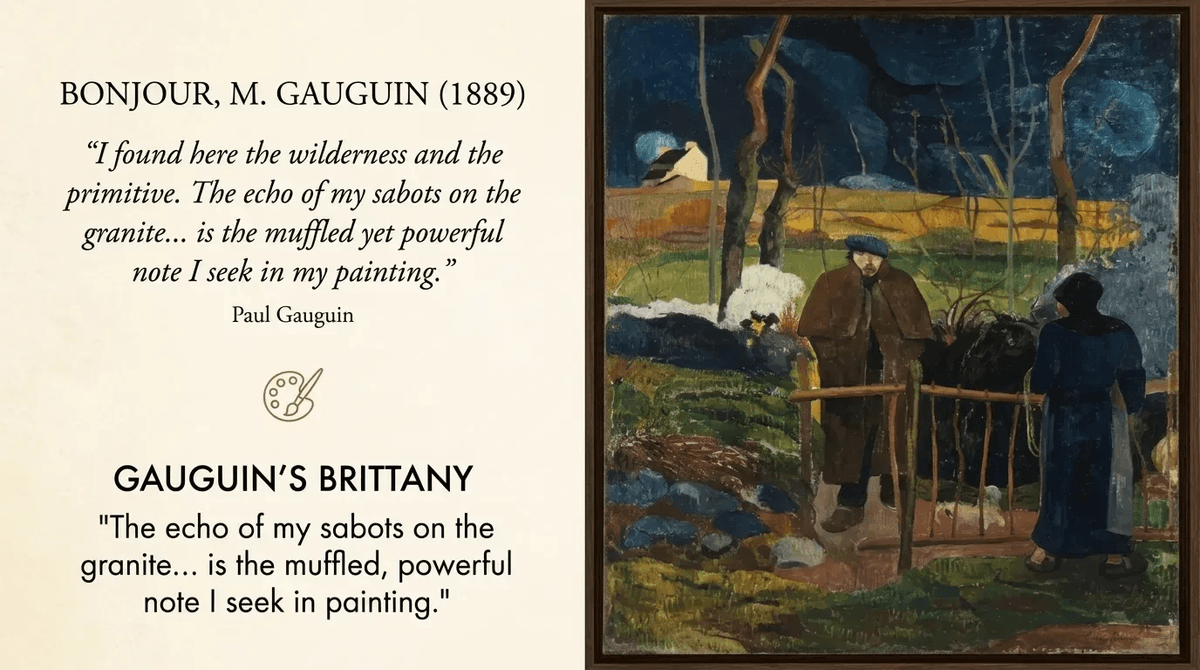
By the 1880s, a sense had emerged that art's direct capacity to instigate radical social change, as envisioned by Gustave Courbet and earlier avant-gardists, was limited. Artists' colonies offered an alternative form of social experimentation, theorizing an existence where artists could live in perceived harmony with a rural populace, seen as uncorrupted by modernity, while simultaneously fostering intellectual camaraderie among peers. Paul Gauguin's intense desire for a more primitive, simpler, and vital existence was a powerful driving force for this self-proclaimed "outsider." Gauguin's multiple visits to Brittany attest to this pursuit. In the autumn of 1888, he and Vincent van Gogh briefly formed an artist's colony-of-two in Arles, France. The "incompatibility of temperament" that Gauguin cited as overwhelming this creative stimulus (Van Gogh, by contrast, described their discussions as "excessively electric") was a dynamic often repeated throughout the history of artists' collectives. In 1891, Gauguin notably left Europe for Tahiti, seeking an idealized "Arcadia" where he hoped to find a simpler, more 'authentic' way of life, reflecting a romanticized, albeit Eurocentric, notion of indigenous cultures.
Artistic communities also thrived in urban settings. In 1902, the sculptor Alfred Boucher established La Ruche (The Beehive) just outside Paris, a complex of studios whose unusual circular architecture fostered close interaction among artists in both their creative practice and daily lives. Such low-cost collective urban artist communities have appeared repeatedly throughout history. However, a recurring pattern has seen property developers later capitalize on the desirability of these artist-pioneered areas, leading to gentrification that ultimately prices out the very artists who initially made them fashionable.