Art, deeply intertwined with illusion and imagination, inevitably prompts questions about its own authenticity: what is genuine, and what is counterfeit? This complex inquiry rarely yields straightforward answers. Nevertheless, the confidence and trust we invest in a work's authenticity profoundly shapes our engagement with art.
The debate surrounding authenticity often draws a sharp line between believers and skeptics. For 16th-century Protestant Reformers in Northern Europe, countless ordinary splinters of wood were dubiously venerated as fragments of the True Cross, and relics like those purportedly from Noah's Ark were dismissed as mere lifeless lumber. Yet, for those who genuinely believed in their authenticity, the sacred aura and miraculous healing powers of these relics remained fully potent—a psychological mechanism that operates similarly in the realm of art. When an artwork is believed to be genuinely created by a specific hand, or to document a lived experience, this is paramount to the viewer's imaginative engagement. Consequently, when a celebrated masterpiece is exposed as a forgery or misattributed, the audience often experiences a profound sense of disillusionment and betrayal.
The Romantic Touchstone and Conceptual Art's Challenge
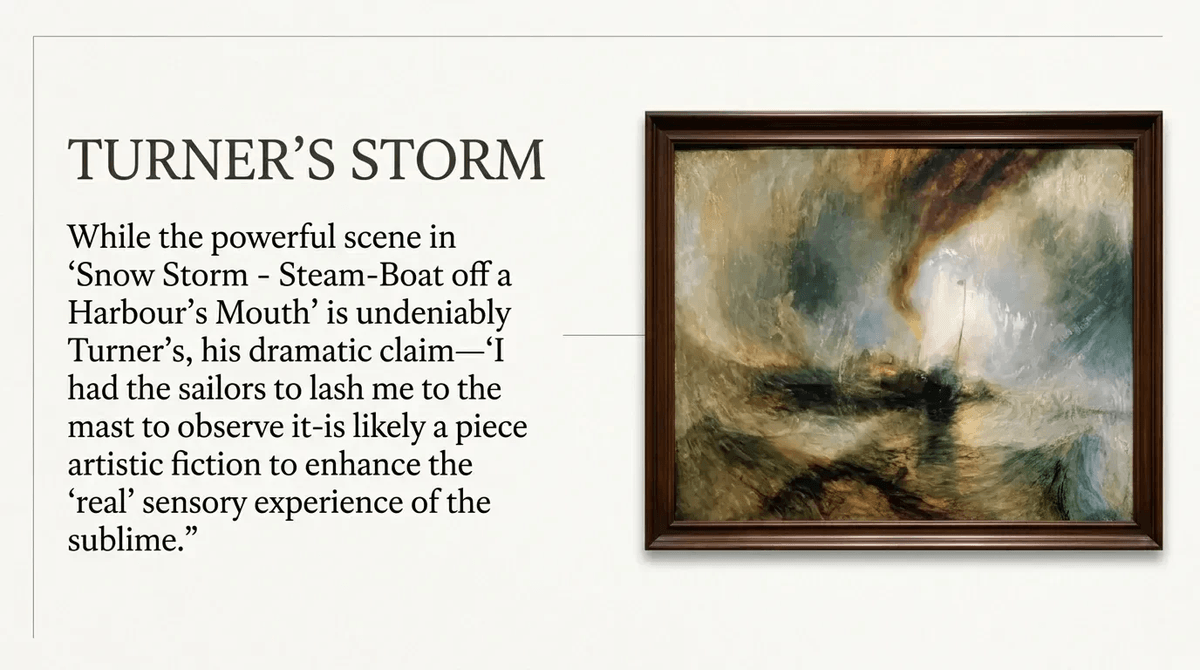
For the Romantic artist, personal experience—preferably of an extreme nature—served as the ultimate touchstone of authenticity. This ethos is epitomized by J.M.W. Turner’s legendary account of his painting Snow Storm—Steam-Boat off a Harbour’s Mouth (1842): "I got the sailors to lash me to the mast to observe it... I did not expect to escape." While the empirical accuracy of Turner's claim is debatable, the power of his tempest lies not in journalistic fidelity, but in its emotional resonance and the perceived authenticity of a profoundly lived experience. This Romantic insistence on the authenticity of lived experience has endured. For instance, Richard Long’s text pieces, documenting his epic solitary walks, serve as a solemn guarantee that the artist actually traversed these remote landscapes rather than merely imagining them at his desk. Without this trust in their factual authenticity, such works might lose their profound, evocative power.
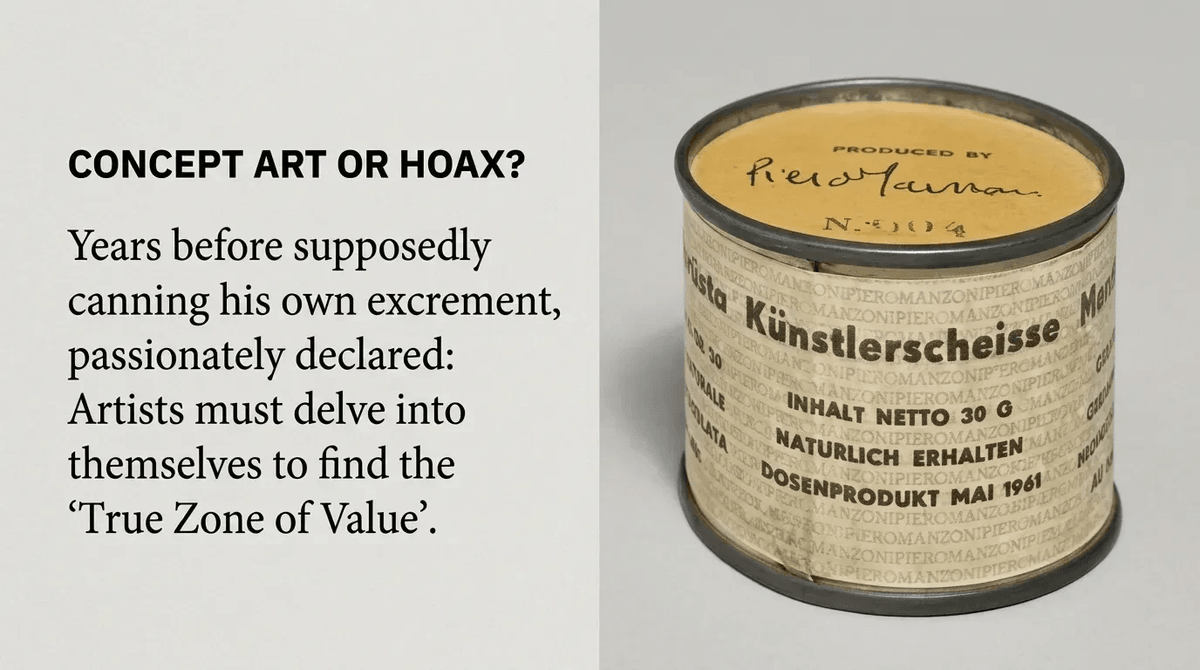
In the 20th century, artists adopted a variety of personas—revolutionaries, tricksters, pranksters, and co-conspirators—to question the very definition of "authentic" art. They suggested that whatever an "authentic" artist produces, touches, or packages, by definition, becomes authentic art. The classic instantiation of this is Piero Manzoni’s Artist’s Shit (Merda d’artista) (1961)—ninety canned tins, each labeled in Italian, German, French, and English, cheekily offered for sale at the equivalent weight-value of gold. While it has been rumored by his contemporary Agostino Bonalumi that the cans were actually filled with plaster, the ultimate conceptual punchline is that the true medium of the work was not excrement, but the audacious gesture and the conceptual authenticity of the artist's action.
Reattribution and Market Value
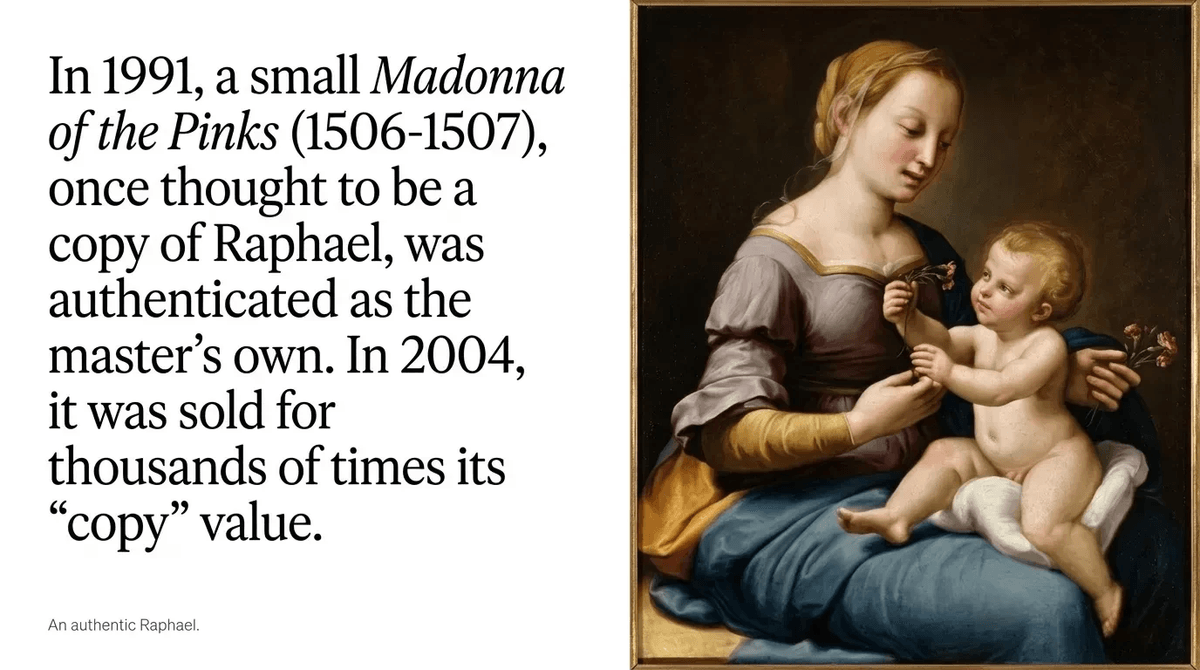
The concepts of authenticity and value are heavily reliant on intangible assets, leaving them inextricably bound to the caprices of the art market. The small painting of The Madonna of the Pinks (1506-1507) by Raphael, once thought to be a copy, was definitively authenticated as an autograph work by the master in 1991. Its financial value skyrocketed following this dramatic reattribution and rise to fame, being valued at £22 million (approximately €20 million) and subsequently acquired by the National Gallery in London on the strength of its exceptional aesthetic merits.
This episode highlights how the belief in a work's genuine authorship can dramatically transform its perceived value and cultural significance, reinforcing the profound impact of authenticity on our understanding and appreciation of art.