The pictorial motif of the "view through a window" reaches back to antiquity, when Roman wall painters used trompe-l'œil frames to create the illusion of looking through solid masonry into gardens beyond. In the Western Renaissance, however, the window became far more than an architectural detail—it became the defining metaphor for painting itself.
Alberti’s "Open Window" (Aperta Finestra)
An architectural window serves a dual purpose: it admits light and air into an enclosed room while granting those inside a framed view of the outside world. From the 15th century through the 20th, Western painting was conceived in precisely these terms—as a portal that dissolves the physical wall between the viewer’s space and the world of the image.
In his groundbreaking treatise On Painting (De pictura, 1435), Italian Renaissance humanist Leon Battista Alberti formulated the laws of linear perspective and famously declared that an artist should treat the rectangular frame of the painting as "an open window (aperta finestra) through which the subject to be painted is seen." By anchoring the viewer and the painted scene within a single unified geometric grid, perspective turned the flat surface of the panel into a transparent pane opening onto receding depth.
Northern Renaissance Portals: Van Eyck, Van der Weyden, and Memling
While Italian theorists conceptualized the canvas itself as a window, 15th-century Northern European masters made the literal window a central feature inside their paintings. Perhaps because cooler northern climates kept domestic and devotional life indoors, Netherlandish painters like Jan van Eyck and Rogier van der Weyden delighted in staging sacred scenes inside intimate rooms pierced by open casements and loggias.
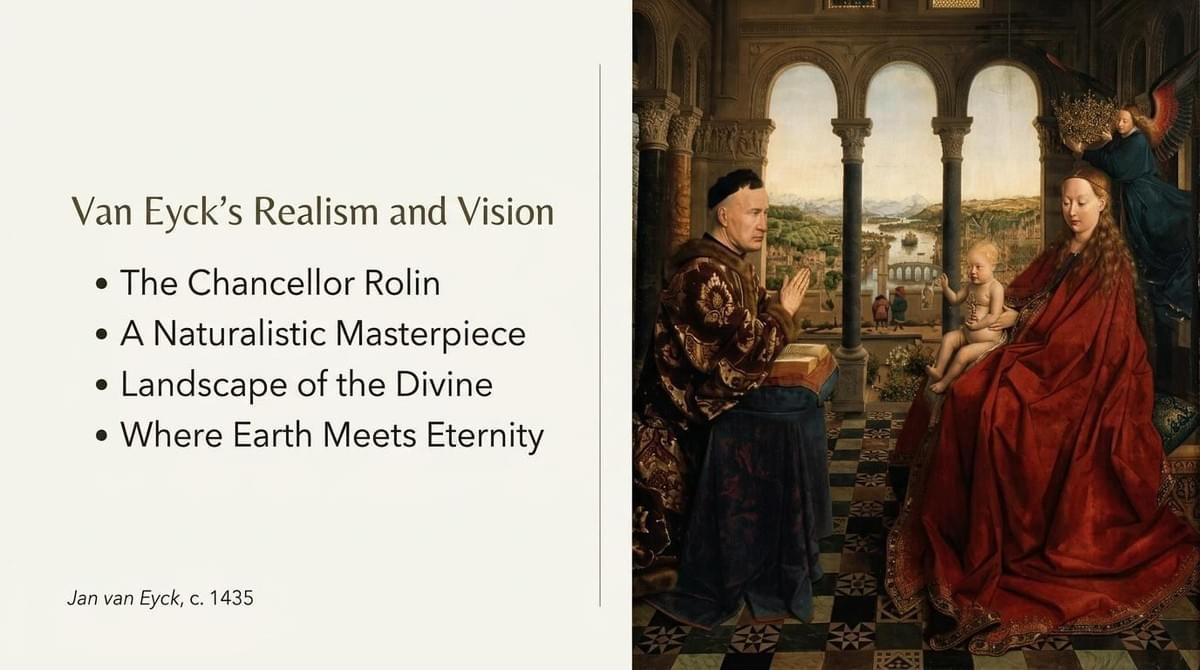
In Jan van Eyck’s Madonna of Chancellor Rolin (c. 1435), the triple-arched arcade does far more than provide a backdrop: it draws the viewer’s eye past the kneeling donor and the Christ Child into a luminous, microscopic river landscape that unites earthly realm and heavenly paradise. A generation later, in Hans Memling’s Donne Triptych (c. 1478), sunlit pastoral countryside unfolds smoothly behind the architectural columns and doorways, infusing sacred stillness with palpable everyday reality.
Thresholds of Contemplation: Hiroshige’s Edo and Modernist Abstraction
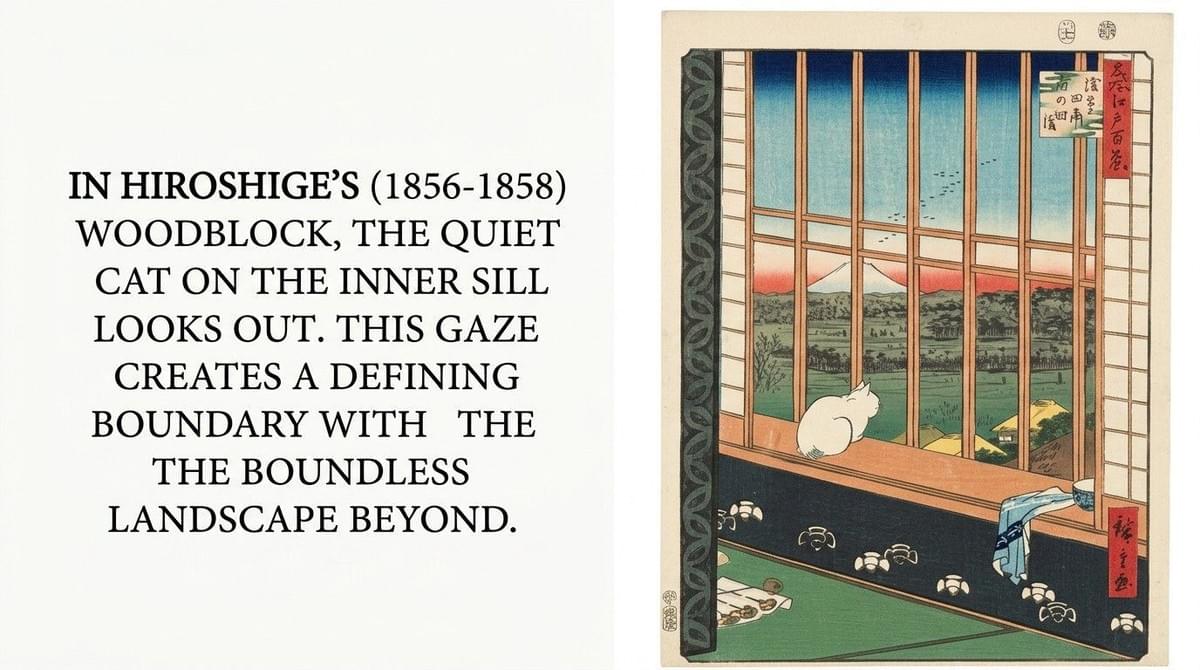
In the 19th century, both European Romantic painters (such as Caspar David Friedrich) and Japanese ukiyo-e printmakers used the interior window sill as a threshold between quiet solitude and the vastness of nature. In Asakusa Ricefields and Torinomachi Festival (1857), from One Hundred Famous Views of Edo, Utagawa Hiroshige places the viewer inside an upstairs room looking out past wooden window bars: a solitary white cat sits quietly on the sill, gazing across festive processions and autumn fields toward snow-covered Mount Fuji on the horizon.
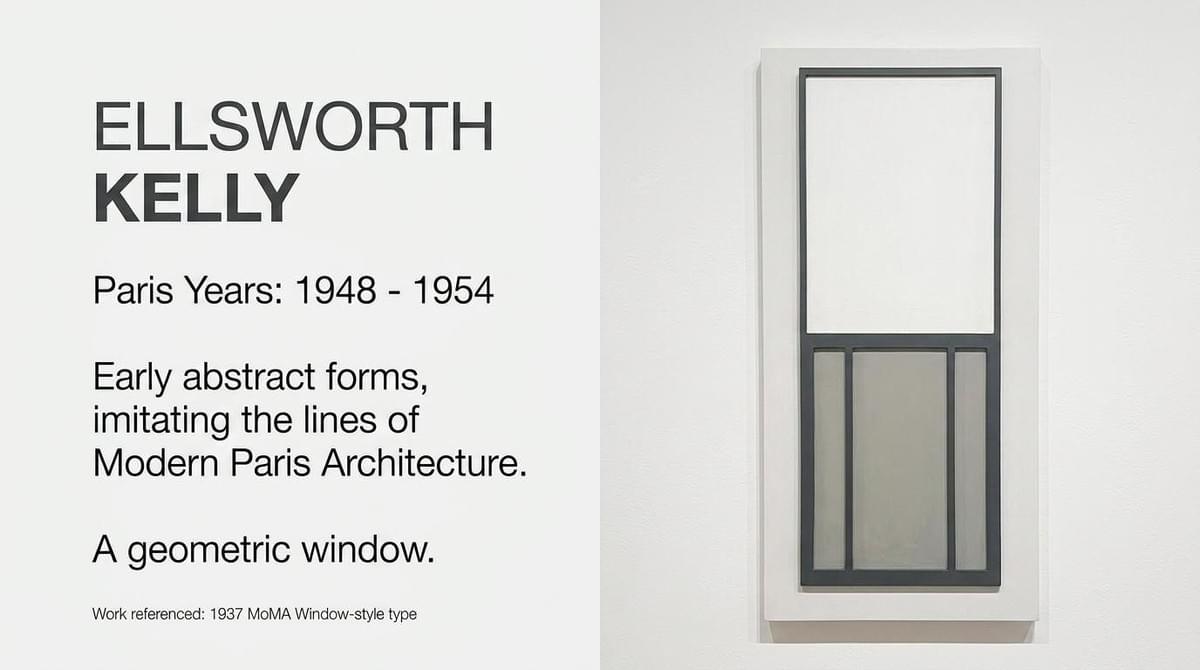
In the 20th century, modernists overturned Alberti’s 500-year-old illusionism. Rather than looking through the canvas into fake three-dimensional depth, artists from Henri Matisse to Ellsworth Kelly asserted the flatness of the picture plane. In Kelly’s landmark Window, Museum of Modern Art, Paris (1949), the window no longer reveals a landscape beyond; instead, its opaque gray-and-white panels and wooden frame become the artwork itself—closing Alberti’s window to open a new chapter in modern abstraction.