Since antiquity, Western art has been deeply intertwined with mathematical thought. Guided by the ancient Greek conviction that the cosmos is structured by number, artists across the centuries have turned to geometry, ratio, and proportion to give visible form to ideal beauty—and, later, to confront the mystery of the infinite.
Classical Harmony: From Ancient Greece to the Renaissance
Ancient Greek philosophers articulated aesthetic beauty in explicitly mathematical terms. From the Pythagoreans and Plato, who revered the circle and the five regular Platonic solids as emblems of cosmic perfection, to Aristotle, who wrote in his Poetics (mid-4th century BCE) that beauty resides in magnitude, order, and the harmonious relationship between parts and the whole, geometry was seen as the blueprint of nature. During the 15th and 16th centuries, Italian Renaissance artists—striving to rival and surpass classical antiquity—placed mathematical proportion at the very heart of their creative practice.
Piero della Francesca and Leonardo’s Vitruvian Man
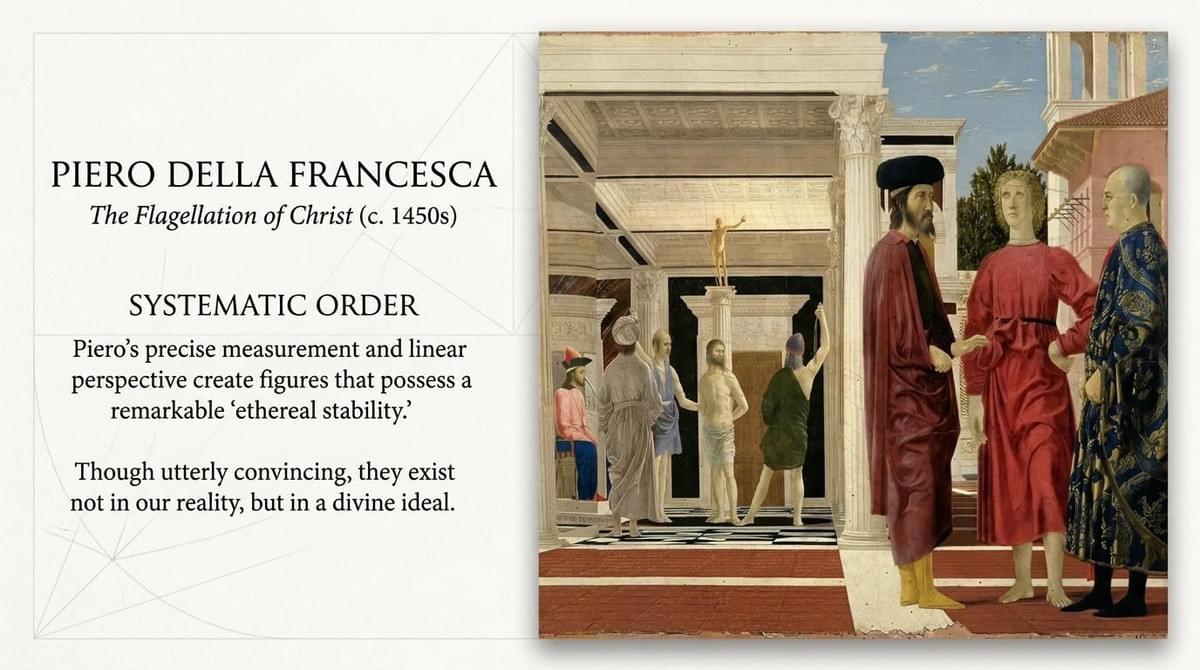
Among Renaissance masters, Piero della Francesca (c. 1415–1492) occupied a singular position: he was not only a supreme painter, but one of the foremost theoretical mathematicians of his age. His pioneering treatises—including De prospectiva pingendi (On Perspective for Painting) and Libellus de quinque corporibus regularibus (On the Five Regular Solids)—combined rigorous Euclidean geometry with detailed diagrams showing how to project complex three-dimensional bodies and architectural spaces onto a flat two-dimensional plane.
A generation later, Leonardo da Vinci (1452–1519)—who illustrated his friend Luca Pacioli’s treatise De divina proportione (On the Divine Proportion, 1509)—sought the mathematical ratios governing the human body itself. Believing that painting, architecture, and music share universal "harmonious proportions," Leonardo created his iconic Vitruvian Man (c. 1490). Translating the Roman architect Vitruvius’s treatise De architectura (Ten Books on Architecture), Leonardo demonstrated how a man with extended arms and legs fits simultaneously inside the two most perfect geometric figures—the earthly square and the cosmic circle.
Romanticism, Kant’s "Mathematical Sublime," and the Infinite
Where Renaissance artists used mathematics to measure finite harmony, 18th- and 19th-century Romanticism embraced the mathematical concept of the infinite. In his Critique of Judgment (1790), the German philosopher Immanuel Kant defined the "Mathematical Sublime" as the mingled vertigo and awe awakened when human imagination confronts vastness beyond all measurement.
Nineteenth-century Romantic painters translated this encounter with the infinite onto canvas—from Caspar David Friedrich’s The Sea of Ice (1823–1824) and John Constable’s Stonehenge (1835) to J.M.W. Turner’s Snow Storm: Hannibal and His Army Crossing the Alps (1812). Abandoning a fixed Renaissance vanishing point and stable horizon, Turner’s swirling vortex pulls the viewer into a boundless three-dimensional abyss—echoing Percy Bysshe Shelley’s vision of vast nature as the soul’s home and William Blake’s poetic call to "Hold Infinity in the palm of your hand."
The Fourth Dimension, Mario Merz’s Fibonacci Spirals, and Fractals
Mathematical thought took radical new turns in 20th-century art:
- The Fourth Dimension and Concrete Art: Early 20th-century Cubists, Suprematists (such as Kazimir Malevich), and Marcel Duchamp drew on non-Euclidean geometry and the "fourth dimension" to shatter traditional three-dimensional space. In the 1930s through the 1950s, European Concrete and Constructivist artists—such as Max Bill and Kenneth Martin—used pure mathematical progressions to build self-contained geometric worlds.
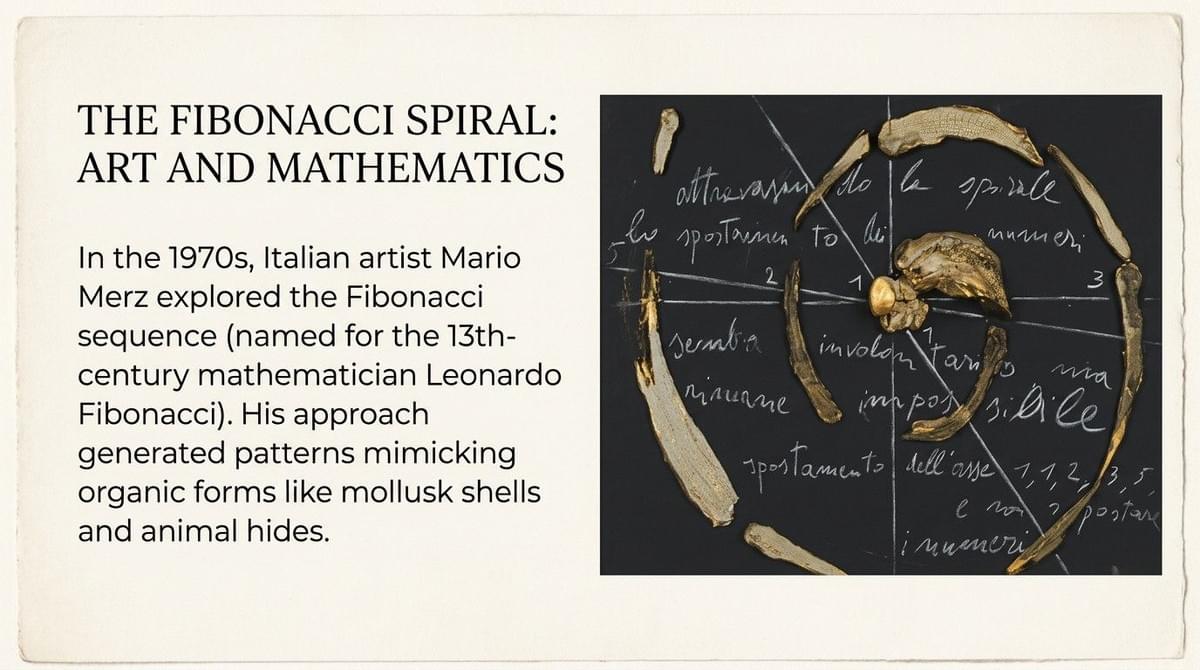
- The Fibonacci Sequence and Chaos Theory: In the 1970s, Italian Arte Povera master Mario Merz (1925–2003) made the Fibonacci sequence (1, 1, 2, 3, 5, 8, 13...—where each number is the sum of the two preceding ones) his signature motif, tracing organic growth patterns in neon numbers, snail shells, and spiral tables. By the late 20th century, chaos theory, fractal geometry, and computer algorithms opened yet another frontier—allowing contemporary artists to generate infinite complexity from simple mathematical rules.