Although drying oils had been used in European workshops since the Middle Ages, it was in the early 15th century that Northern European painters unlocked the full expressive potential of oil paint. Over the next five centuries, oil became the defining medium of Western art—prized equally for its jewel-like inner glow and its visceral, sculptural texture.
The Alchemy of Oil: Glazes, Grounds, and Impasto
Oil paint is made by grinding powdered pigments into a drying vegetable oil—most commonly linseed, walnut, or poppyseed oil. Unlike egg tempera or watercolor, which dry rapidly by evaporation, oil cures slowly through oxidation, allowing artists to blend wet-into-wet and rework compositions over days or weeks. Thinned with volatile solvents like turpentine, oil flows in delicate, translucent washes; applied straight from the palette knife or brush, it stands up in stiff peaks.
Because dried oil has a unique refractive index, light passes through thin transparent layers—known as glazes—striking the ground beneath and bouncing back to the viewer’s eye like light through stained glass. A bright white chalk ground lends radiant luminosity to deep crimson or ultramarine glazes, while a dark toned ground (imprimatura) gives overlaid highlights dramatic depth. At the opposite extreme, artists use opaque impasto—thick, tactile ridges of paint—to catch physical light right on the canvas surface.
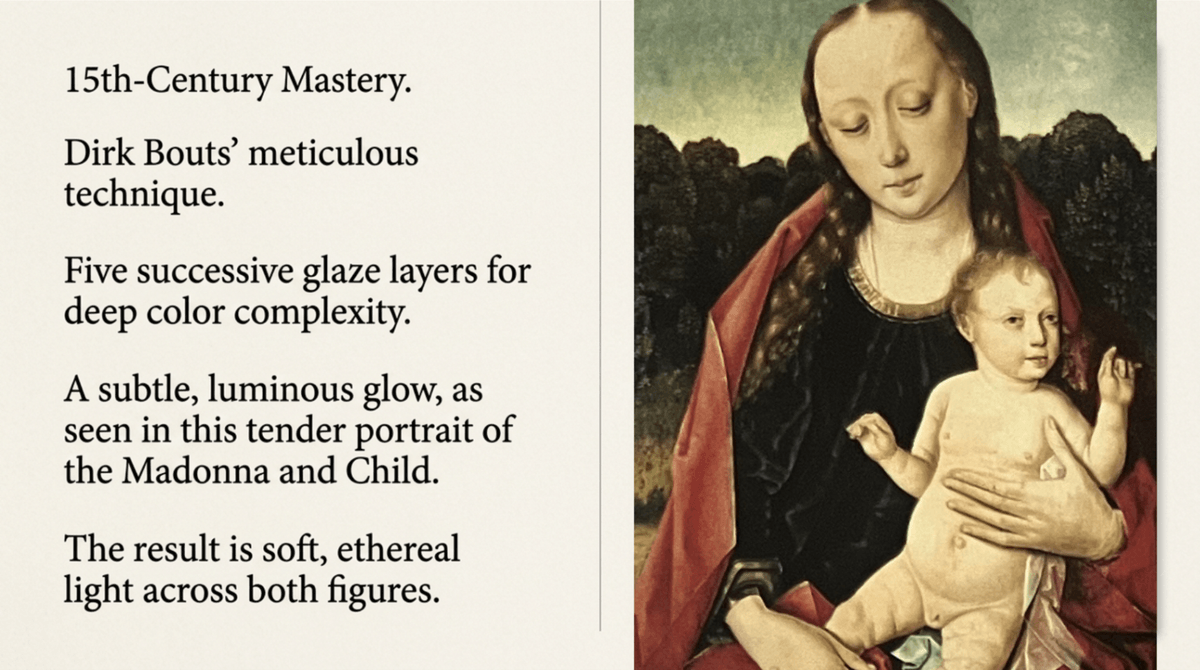
Northern Light: Campin, Van Eyck, and Dieric (Dirk) Bouts
While 15th-century Netherlandish masters such as Robert Campin, Jan van Eyck, and Dieric (Dirk) Bouts did not invent oil paint, they perfected its layered application on smooth wood panels. Supplanting traditional egg tempera, they built up successive microscopic glazes to mimic the moist sheen of human skin, the sparkle of gold embroidery, and the soft nap of velvet—controlling the finest sable brushes to render individual strands of hair and distant atmospheric light.
Venetian Colore and Titian’s Pentimenti
Once cured, oil paint forms a tough, flexible film—a property that allowed 16th-century Venetian masters like Titian to shift from rigid wood panels to large woven linen canvases. In stark contrast to the meticulous underdrawings and porcelain finish of Northern panel painters, Titian often painted directly onto the canvas with bold, broken brushwork. Relying on oil’s forgiving nature, he constantly revised his compositions on the fly; modern X-radiography has revealed dramatic pentimenti ("changes of mind") beneath the surface of his masterpieces, where figures and gestures shifted markedly from his initial conception.
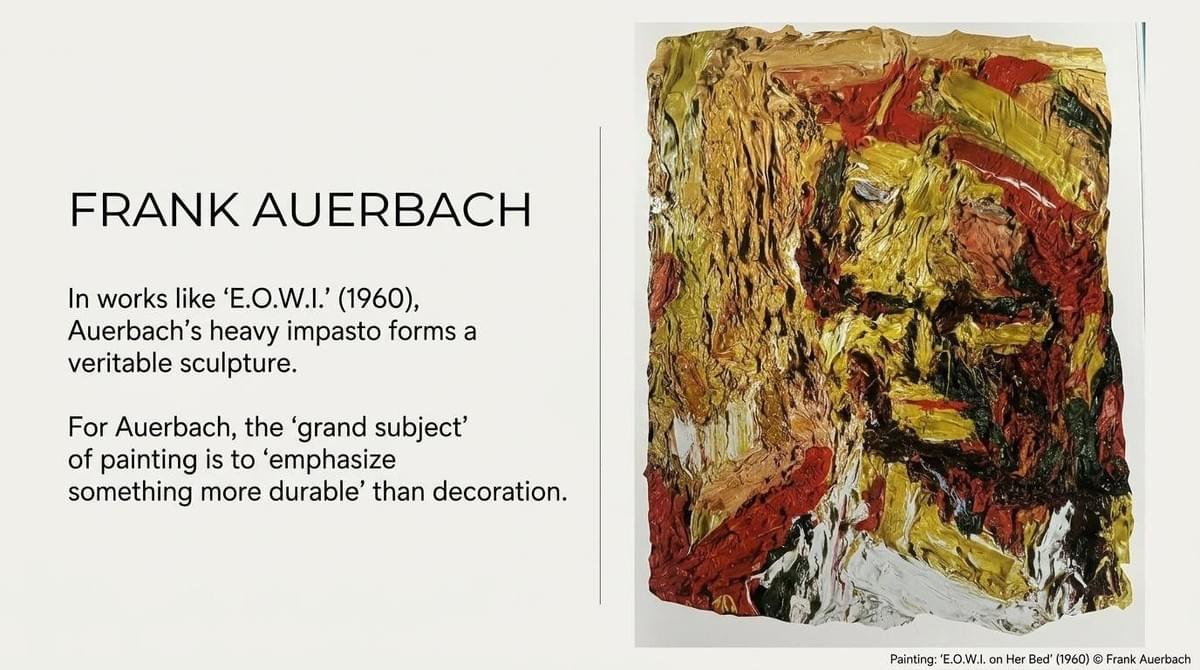
From Workshop Apprentices to Paint Tubes and Frank Auerbach
During the Renaissance, masters and their apprentices spent hours laboriously grinding mineral pigments on stone slabs to prepare fresh oil paint each day. By the 17th and 18th centuries, professional colormen took over this craft, and in 1841 the invention of the collapsible metal paint tube freed artists from the studio altogether. In the 20th century, painters like School of London master Frank Auerbach pushed the material weight of tubed oil paint to its furthest limit—piling pound upon pound of pigment onto the board until the painted portrait became a three-dimensional monument of living matter.