Long before the invention of movable type, the bound book emerged in the Roman world as a revolutionary medium for uniting word and image. Replacing the unwieldy papyrus scroll with the codex—individual leaves folded and stitched along a spine—gave painters and scribes an intimate new stage, endowing visual art with fresh conceptual and aesthetic possibilities.
The Rise of the Codex and the Word of God
For ancient readers, turning individual pages offered an unmistakable advantage over unrolling fragile papyrus scrolls or sorting through stacks of clay and wax tablets. Compact, sturdy, and easy to shelve or reference at a glance, the codex served both public liturgy and quiet personal study. Early Christians eagerly adopted this format for their sacred scriptures: the very word Bible—derived from the Greek ta biblia ("the books")—reflects how a library of distinct sacred texts was bound together into a single volume to spread Christian doctrine across the Roman Empire and beyond.
Monastic Scriptoria: Vellum, Gold, and Ultramarine
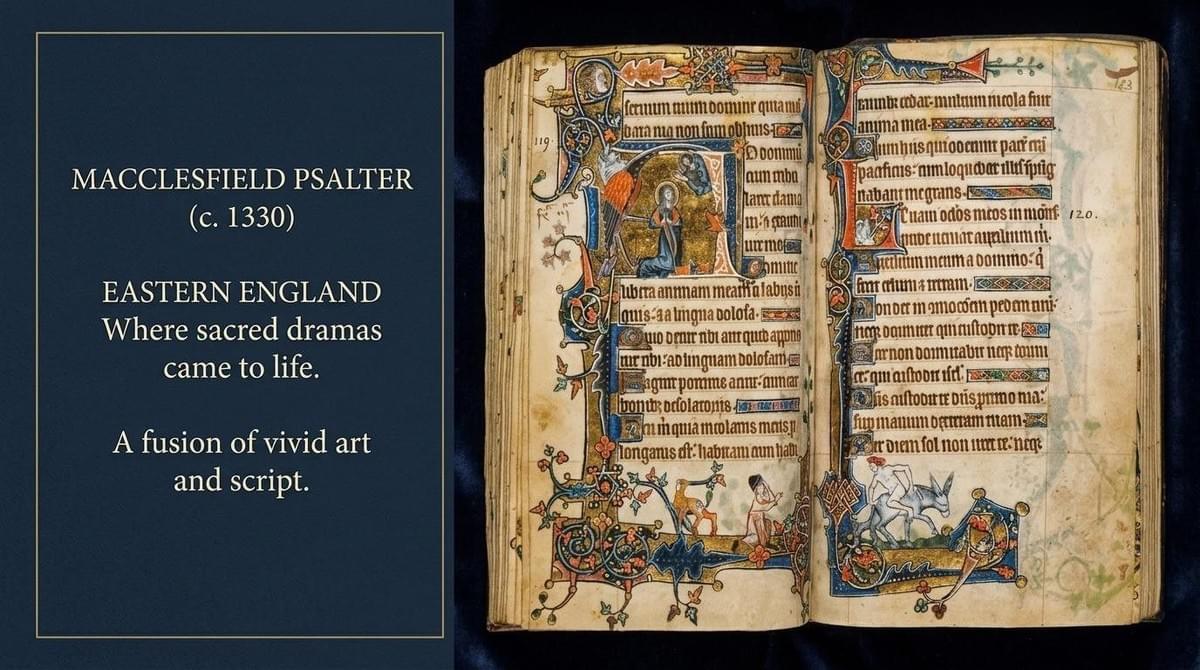
Before Johannes Gutenberg’s printing press transformed Europe in the mid-15th century, every Christian Bible, psalter, Book of Hours, and verse anthology had to be copied and illuminated entirely by hand. Working for months by candlelight in monastic scriptoria—and later in secular urban workshops—scribes and illuminators lavished extraordinary wealth on a single volume. Preparing the parchment or vellum required dozens of sheep or calf skins, while pigments were ground from precious minerals—above all luminous burnished gold leaf and ultramarine extracted from lapis lazuli mined in distant Afghanistan. Masterpieces like the 14th-century English Macclesfield Psalter turned every page turn into an intimate theater of color and devotion.
From the Printing Press to the Modern
Livre d’Artiste
The 15th-century print revolution democratized the book overnight. Paper and movable type made books affordable and reproducible in the thousands, while woodcuts—and later copperplate engravings and etchings—allowed images to be printed alongside text. Over time, book design separated the imaginative illustrator from the reproductive engraver. At its finest, however, literary illustration forged indelible cultural icons: John Tenniel’s wood-engraved illustrations for Lewis Carroll’s Alice’s Adventures in Wonderland (1865) gave timeless visual form to Carroll’s fantasy, while Aubrey Beardsley’s audacious black-and-white drawings for The Yellow Book (1894) came to define fin-de-siècle Decadence.
In the 20th century, vanguard artists reclaimed the book as an original work of art in its own right:
- The Livre d’Artiste: Collaborating with visionary publishers, modern masters created sumptuous limited-edition books—most famously Henri Matisse’s Jazz (1947), published in an edition of 250 copies using vibrant pochoir (stencil) prints derived from his painted paper cut-outs.
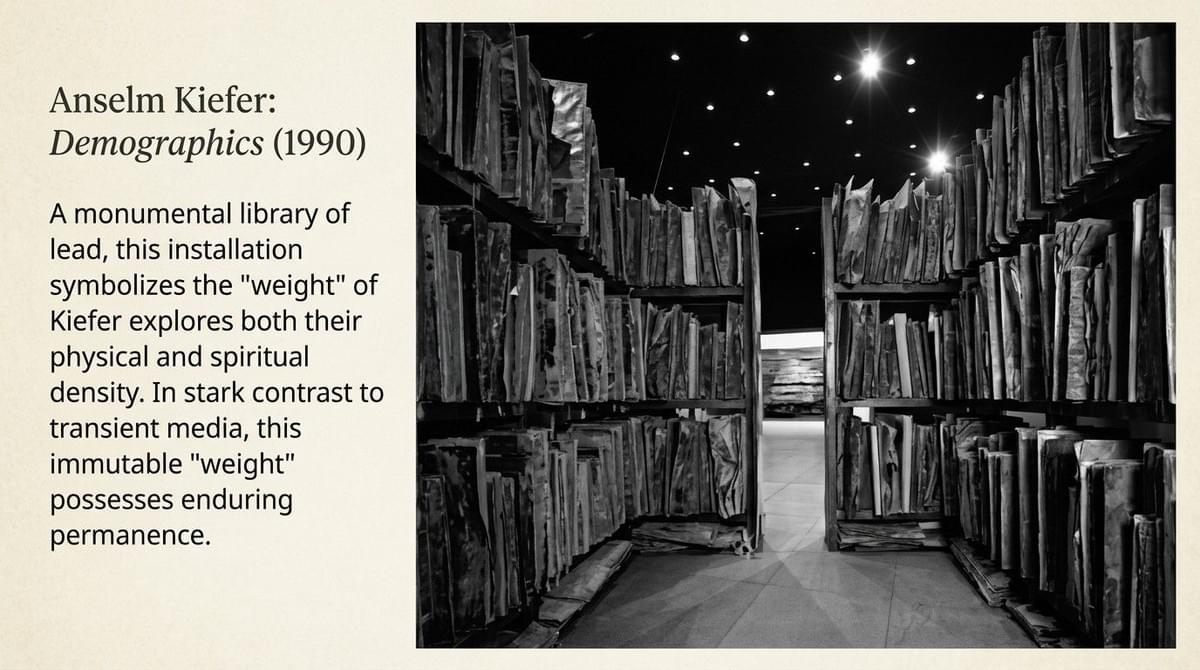
- Contemporary Artists’ Books and Sculptural Libraries: From the 1960s onward, Pop and conceptual artists like Andy Warhol and Ed Ruscha used silkscreen and offset printing to turn the everyday book into an accessible democratic medium. At the opposite extreme, German Neo-Expressionist Anselm Kiefer forged monumental libraries of hammered lead—such as his installation Volkszählung (Census, 1991)—fusing two-dimensional pages and three-dimensional sculpture to give human memory and knowledge the crushing physical weight once reserved for medieval lectern Bibles.