Op Art (Optical Art) harnesses visual perception to create illusions of movement, vibration, and change within static forms. This manipulation of visual reality, often rooted in scientific principles and design methodologies, generates profound psychological and physiological effects in the viewer, challenging the very nature of perception.
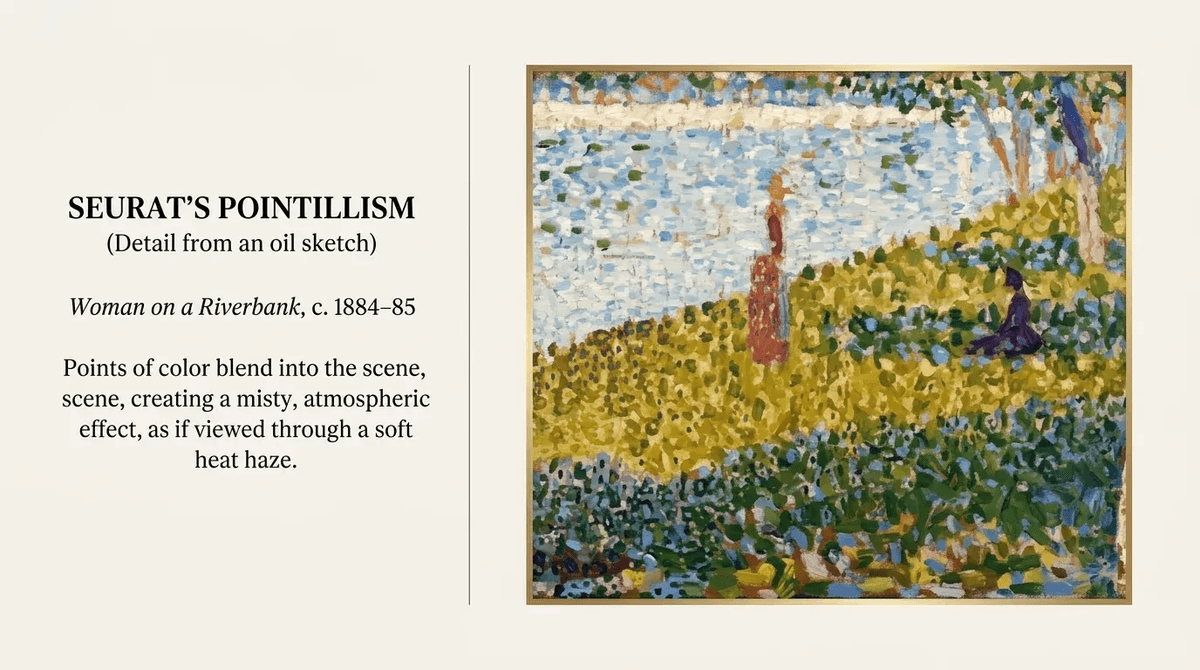
Historically, the human eye's perception and interpretation of visual information have always been central to artistic endeavors. While Renaissance linear perspective profoundly impacted the illusion of space, and later Impressionism explored the transient effects of light and color, it was the late 19th-century scientific approach of Neo-Impressionists (Pointillists) that laid crucial groundwork for Op Art. Painters like Georges Seurat and Paul Signac systematically pioneered the technique of using small, distinct dots of color that optically blend in the viewer's eye, directly investigating the mechanics of vision. This systematic exploration of optical mixing and color theory directly anticipated Op Art's later investigations into movement and illusion.
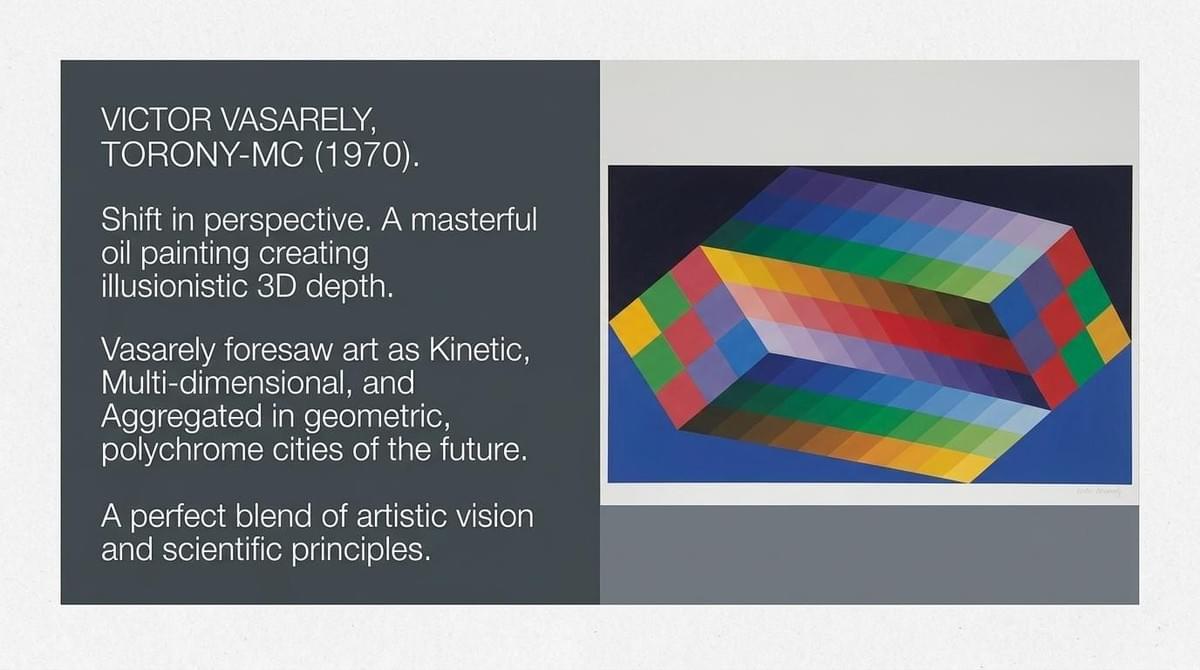
In the mid-20th century, a rigorous interest in purely optical art emerged, spearheaded by Op Art. This movement was widely embraced, raising fundamental questions about the interplay between human perception and artistic intention, fostering a deeper understanding of the subjective nature of visual experience. Victor Vasarely, a central figure in Op Art, developed key theoretical concepts such as "plastic units" and "kineticism," which informed his abstract geometric compositions. His Planetary Folklore series from the 1960s, for instance, used simple geometric forms arranged in countless permutations, creating dazzling visual effects. Vasarely's approach, which evolved from his background as a graphic designer in the 1920s and 30s, integrated abstract geometric forms into a broader movement that aimed to imbue everyday life with a new, dynamic visual language, envisioning art as integral to future urban environments.
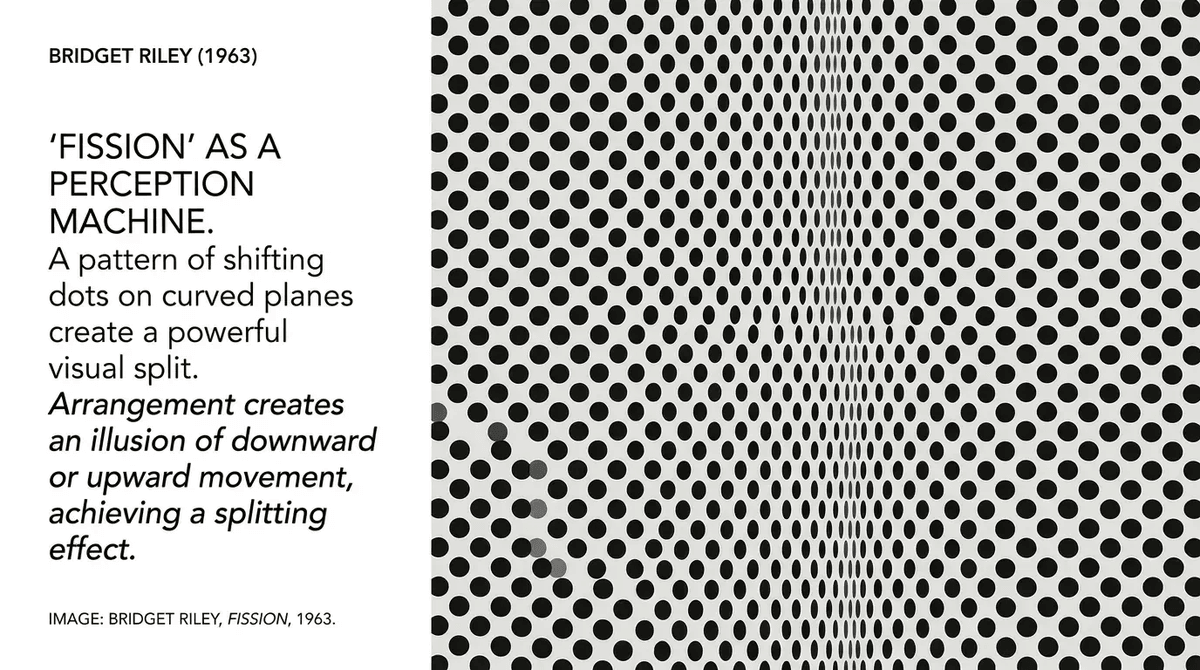
Almost in parallel, the British artist Bridget Riley systematically investigated optical phenomena with a structured style to create powerful vibratory and disorienting visual effects. Unlike Vasarely, whose work often retained a sense of underlying abstract structure or compositional arrangement, Riley's art emphasized pure, immediate perception and optical movement itself. In works like Movement in Squares (1961), the painting functions as a precise perceptual mechanism: its meticulously arranged patterns of small squares, on a seemingly curved plane, generate an optical illusion of descending and ascending forms, creating a powerful sense of shifting and splitting. The absence of visible brushstrokes in Riley's work heightens the directness and immediacy of the optical effect, making it a pure engagement with the viewer's perceptual response rather than an exploration of the artist's hand.