Storytelling is by nature bound to time—events unfold one after another. Yet visual art has the unique power to compress time into a single space, allowing viewers to take in a complex sequence at a glance. Across religion, politics, education, and entertainment, visual artists have spent millennia inventing clever ways to make static images tell moving stories.
To keep familiar tales fresh—or to make unfamiliar stories clear with minimal text—artists rely on visual pacing and composition. When a visual narrative works, it bridges the gap between maker and audience without needing a single spoken word.
Unspooling History in Stone: Trajan’s Column
Erected in Rome in 113 CE, Trajan’s Column translates military history into a monumental visual scroll. Rather than relying on written chronicles, its continuous bas-relief frieze spirals upward from base to summit like a stone musical score, recounting Emperor Trajan’s two victorious campaigns against Dacia (modern-day Romania).
Carved with remarkable documentary realism, the frieze features roughly 2,500 individual figures alongside detailed Roman forts, bridges, and landscapes. Emperor Trajan himself appears more than 60 times up the shaft, anchoring a narrative tradition that shaped Western art for centuries.
Three Moments in One Frame: Continuous Narrative
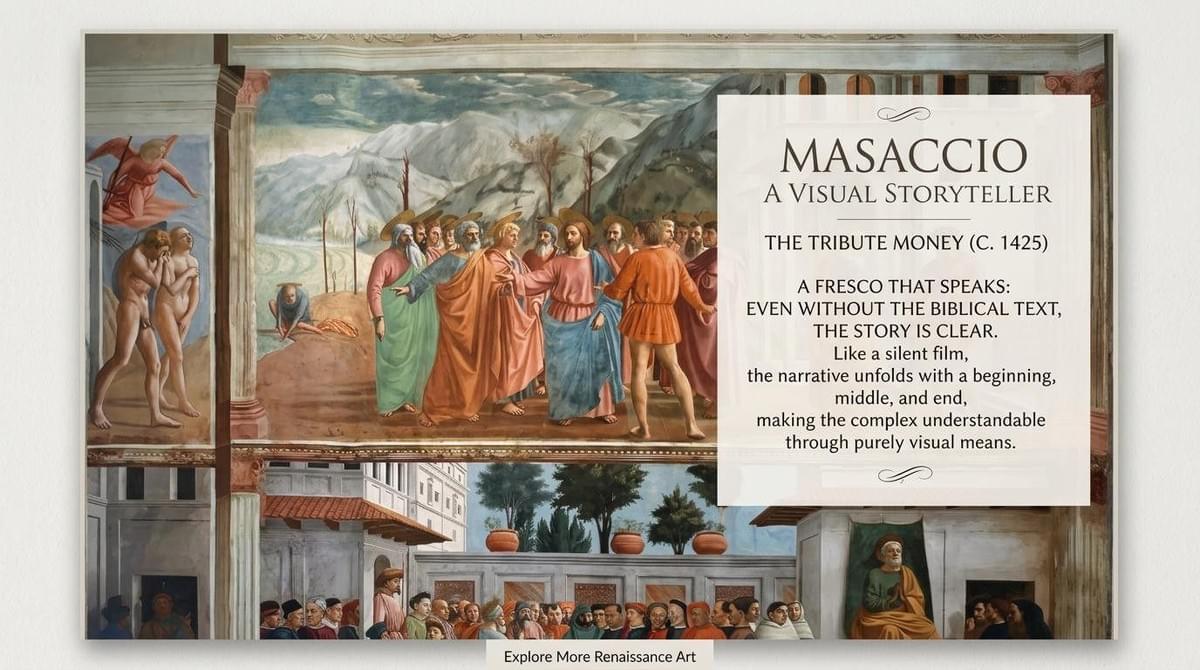
How can a single painting show events that happened at different times? Early Renaissance master Masaccio solved this brilliantly in his fresco cycle on the life of Saint Peter (c. 1425–1427) in the Brancacci Chapel of Santa Maria del Carmine in Florence.
In The Tribute Money, Masaccio uses a technique known as continuous narrative—placing separate moments from the same story within one unified landscape:
- Center (The Confrontation): A Roman tax collector demands temple tax from Christ and his disciples; Christ gestures toward the lake, instructing Peter to catch a fish.
- Left (The Miracle): Crouching by the rocky shore in the distance, Saint Peter pulls a coin from the mouth of a fish he has just caught.
- Right (The Resolution): Moving to the far right of the frame, Peter hands the coin to the tax collector.
Even though the scenes do not follow a strict left-to-right order, Masaccio’s use of gesture and perspective guides the eye seamlessly through the story.
From Cinema to Fragmented Memory
In the modern era, film and television inherited this visual storytelling tradition, typically unfolding character actions in chronological order where every frame advances the plot. Yet contemporary filmmakers and video artists frequently disrupt that linear flow. Drawing on interactive media, split screens, or psychological studies—such as piecing together fragmented human memories or the nonlinear inner worlds of psychiatric patients—contemporary art continues to reinvent how stories are told and experienced.
