White in art can convey a rich spectrum of meanings—from purity, hope, and spirituality to emptiness, plenitude, and expansive space. It can denote either a color in its own right or the absence of all color, deployed by artists to manifest specific localized effects. Across diverse movements, including Neoclassicism, Constructivism, and various forms of Modernism, white has carried profound aesthetic and philosophical significance.
Ancient Symbolism and Shifting Interpretations
Throughout history, objects crafted from ivory, silver, or other white materials have frequently been invested with spiritual or symbolic power. For instance, the white crowns worn by pharaohs and associated with deities like Osiris in ancient Egypt, or the ceremonial ivory masks of the Kingdom of Benin, often linked to the sea god Olokun, signify power, purity, and connection to the divine.
In 17th-century Europe, the use of white in church interiors diverged significantly between Protestant and Catholic contexts. Pieter Saenredam’s masterpiece, The Interior of the Grote Kerk at Haarlem, depicts church walls in pristine white, reflecting the Dutch Protestant rejection of ornate Catholic imagery in favor of quiet contemplation of the Word of God. Conversely, Gian Lorenzo Bernini’s Baroque sculptural masterpiece, The Ecstasy of Saint Teresa (1645–1652), harnesses the inherent whiteness of marble to convey profound spiritual and sensual intensity. Cupid's arrow plunges into the swooning saint's breast; the stark purity of the marble intensifies both the spiritual allegory and emotional depth, aligning with Baroque art's aim to evoke fervent religious experience.
Neoclassical Idealization and Romantic Counterpoint
White played a pivotal role in the lineage of European sculpture, reaching its zenith in the early 19th-century works of Antonio Canova. His classical sculptures are characterized by smooth, expansive, yet tranquil surfaces, meticulously carved marble mimicking the supple texture of youthful skin while maintaining a serene and noble poise for public veneration. During Canova’s era, the color white became indissolubly linked to a sacred reverence for ancient Greek art. Although ancient Greek temples and sculptures were originally painted in vivid polychrome, the 18th-century classical revival, spearheaded by Johann Joachim Winckelmann, championed white as the defining characteristic of Greek sculpture. It came to epitomize purity, ideal form, and the pursuit of timeless beauty. The widespread adoption of Neoclassicism in architecture, fashion, and the decorative arts further propelled the development of 19th-century white marble sculpture, which elevated the idealized human form to a plane of aesthetic and moral contemplation.
However, a reaction to this academic dominance emerged. Beginning with Eugène Delacroix and the Romantic movement, a vibrant resurgence of color continuously revitalized the European art scene, serving as a dynamic counter to the formal rigor and often muted palettes favored by academic art. By this time, some Neoclassical depictions of the human form, despite their initial aims of idealization, were perceived by critics as overly stylized or emotionally restrained.
Modernist Purity and Minimalist Expression
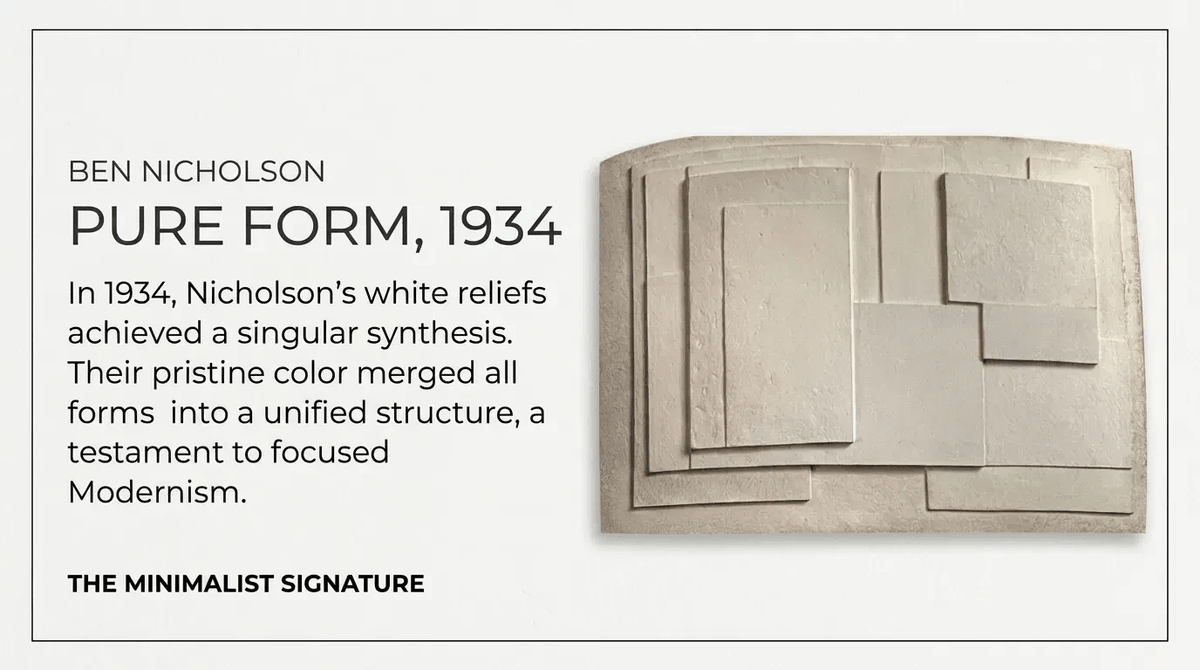
In the 1920s and 1930s, white dramatically reclaimed a central position within geometric abstraction and modernist architecture. Figures like Piet Mondrian, whose Paris studio was famously characterized by its intense, absolute whiteness, used the color to emphasize spatial purity and spiritual harmony. Ben Nicholson’s series of white reliefs operated on a similar principle: art should filter out the chaotic detritus of daily life to reveal what is essential, harmonizing forms into a balanced and fulfilling aesthetic experience.
The rise of Minimalism in the 1960s and 1970s further heralded a revival of these ideals, where white, black, and primary colors were often used to emphasize fundamental structural elements and the viewer's direct perception of the artwork. This is epitomized by works like Sol LeWitt’s Two Open Modular Cubes/Half-Off (1972) and Robert Morris’s Slab (1973), demonstrating white's enduring capacity to convey both presence and absence, simplicity and complexity, across diverse artistic epochs.