History painting, often referred to as istoria in its Italian Renaissance context, stands as one of the most intellectually ambitious and prestigious genres in Western art. Defined by its grand scale, moralizing content, and ambition to depict significant historical, mythological, or biblical narratives, it has served as a powerful medium for expressing civic virtues, religious truths, and collective memory.
Alberti's Vision and the Renaissance Ideal
The concept of history painting was first systematically articulated in the early 15th century by the Italian polymath Leon Battista Alberti. In his seminal treatise De Pictura (On Painting, 1435), Alberti championed istoria as the supreme pinnacle of the painter's art, urging artists to elevate their status from mere craftsmen to intellectuals. He laid down fundamental principles: a composition should feature a variety of figures of differing ages and characters, arranged to convey a compelling narrative. These works were expected to be grounded in classical mythology, ancient history, or biblical narratives, captivating and emotionally moving both the educated and the unlettered viewer.
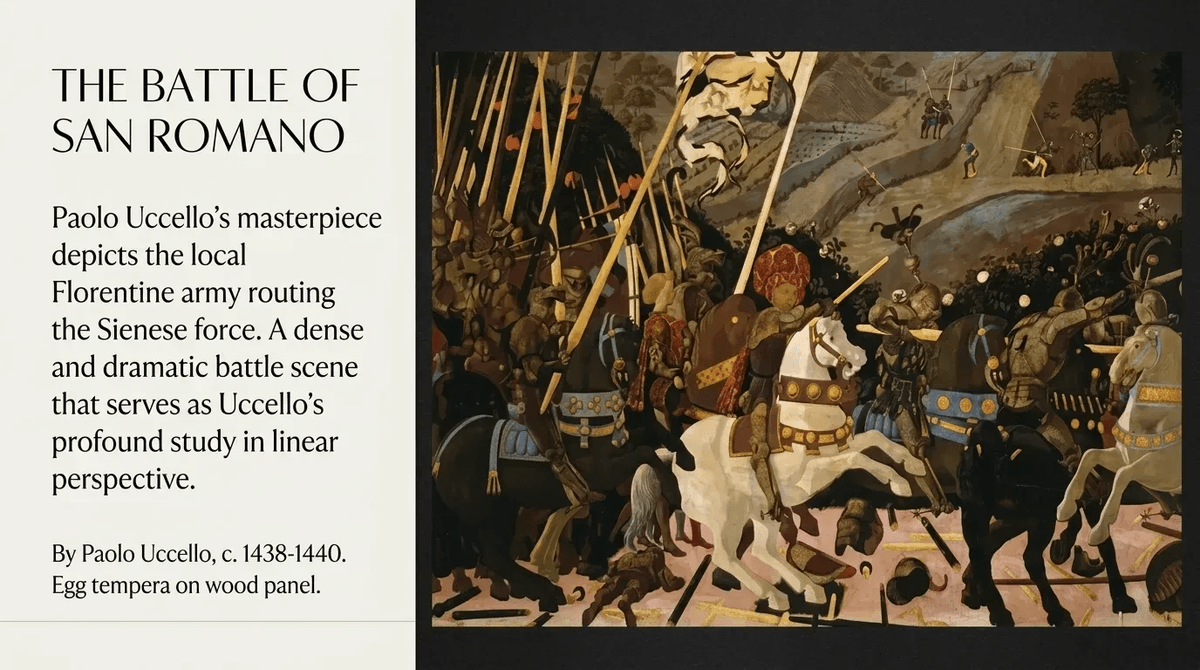
While Alberti's ideas were revolutionary, their widespread adoption was gradual. Over the latter half of the 15th century and into the High Renaissance, Italian masters like Andrea Mantegna and Raphael fully embraced and integrated these principles into their work. An earlier notable exception was Paolo Uccello’s triptych The Battle of San Romano (1438–1440), depicting a contemporary clash between Florence and Siena. Though not strictly aligned with Alberti's call for narrative clarity due to its dense, claustrophobic figures, Uccello’s work still demonstrates the ambition to monumentalize an event and to incorporate classical elements, such as the Florentine commander Niccolò da Tolentino, whose equestrian pose was modeled on the famous statue of Marcus Aurelius. This practice of casting contemporary figures in the mold of classical heroes aimed to instill renewed civic confidence.
The Academic Hierarchy and Neoclassical Reinvention
Throughout the 17th and 18th centuries, history painting reigned supreme within the academic hierarchy, considered the most noble and intellectually demanding genre. However, its mandatory status as a test of artistic competence often led to formulaic, derivative works relying heavily on pastiche.
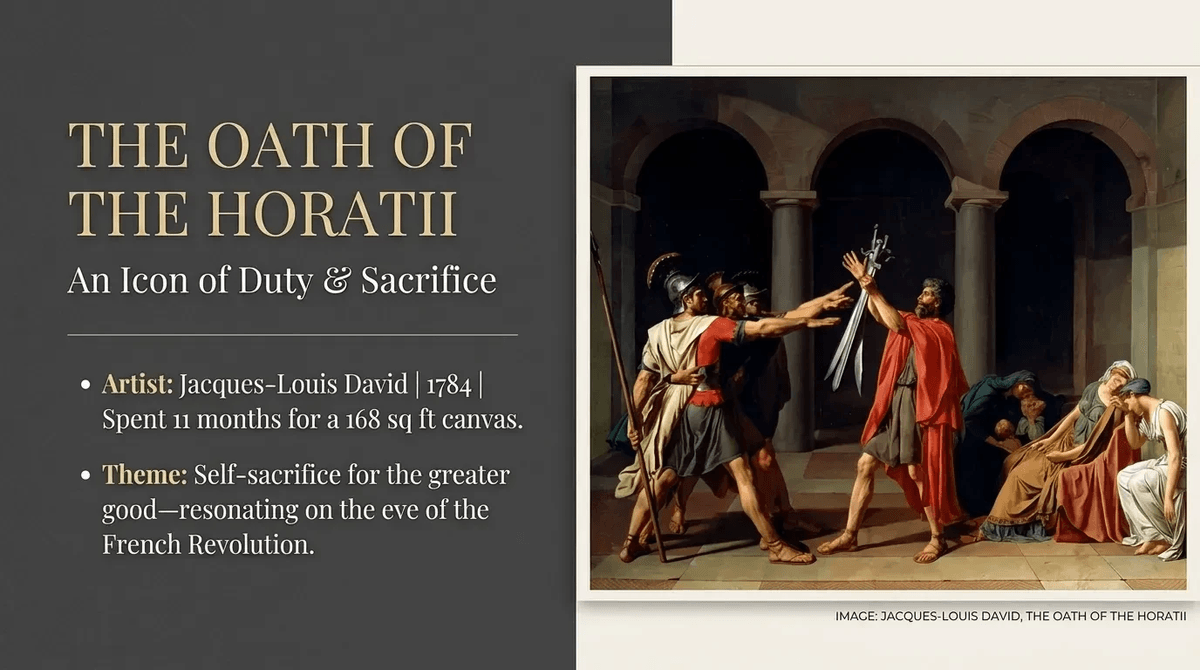
This trend was radically challenged by Jacques-Louis David in his groundbreaking masterpiece, The Oath of the Horatii (1784). David redefined history painting for the Neoclassical era, eschewing the lyrical grace of the Rococo and infusing his canvas with a stark, austere classical gravity. By channeling ancient Roman civic virtue and heroic self-sacrifice, David revived a monumental vision of the past that exerted a colossal historical impact. His work, created on the eve of the French Revolution, played a vital role in reinjecting moral and political purpose into French visual arts.
Modern Reflections on History and Memory
In the 20th and 21st centuries, the approach to history painting shifted dramatically. Artists turned their focus toward capturing the raw pulse of their own era, often moving away from grand narratives to explore history through intimate personal experiences or reflections on collective trauma.
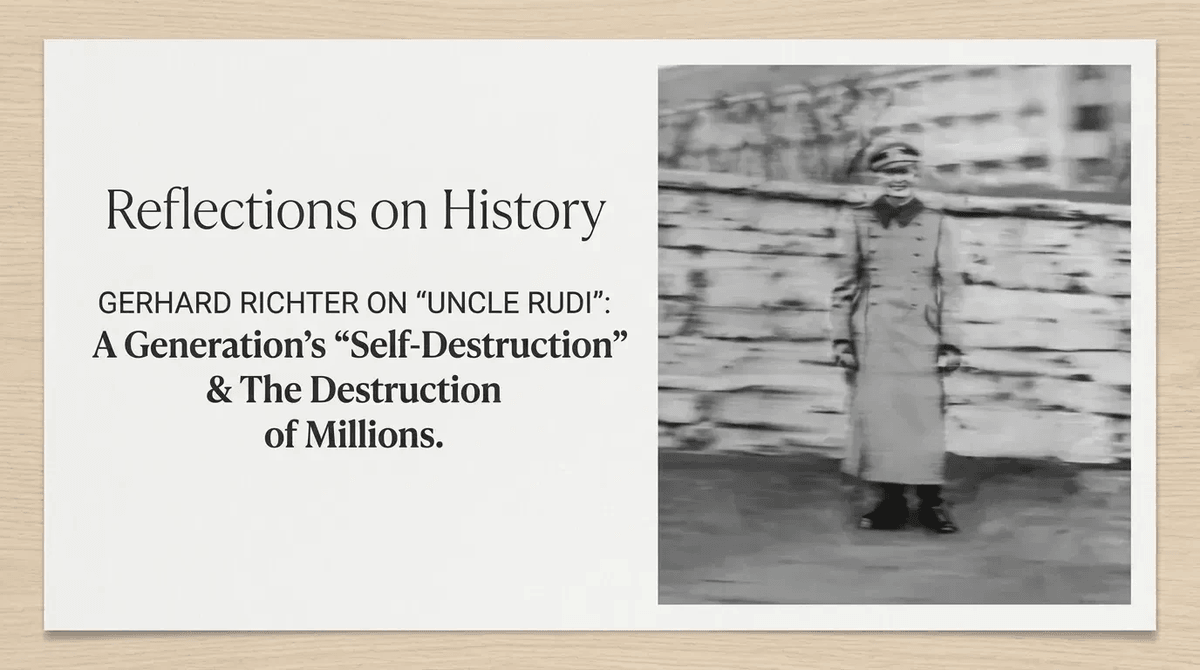
In the wake of World War II, German artists like Anselm Kiefer and Gerhard Richter profoundly re-engaged with history, suggesting that it unfolds within individual lives, specific sites, or even desolate landscapes. Richter's poignant painting Uncle Rudi (1965), based on a personal photograph, subtly alters its photographic qualities. The seemingly ordinary title carries an immense historical weight, prompting deep self-reflection on the Holocaust and the horrors of war. While Uccello’s 15th-century battle scene is physically packed with armored soldiers, Richter achieves a different kind of suffocating density—not through physical bodies, but through the haunting, blurred lens of memory and historical trauma.