Mirrors have always captivated the human imagination, blurring the lines between appearance and truth. As Leonardo da Vinci famously declared, "The painter's mind should be like a mirror," reflecting and absorbing the world with objective clarity. From the Renaissance onward, mirrors have been indispensable tools and profound subjects in European art, becoming synonymous with the very act of artistic representation and its philosophical implications.
From Metal to Glass: Ancient Reflections
Early mirrors, crafted from polished obsidian or metal alloys, were known across the ancient world—from Egypt and the Near East to classical Rome. Though often small and producing somewhat indistinct images, they were used for personal adornment, ritual, and as valued decorative objects. A significant breakthrough came in 15th-century Venice, where artisans perfected the production of mercury-backed glass mirrors. These innovations allowed for larger, clearer, and more precise reflections, transforming mirrors from luxury curiosities into essential instruments for scientific inquiry and artistic practice.
Renaissance Vision: Mirror as Tool and Subject
Renaissance artists quickly recognized the mirror’s dual potential: as a practical studio tool and a powerful artistic motif.
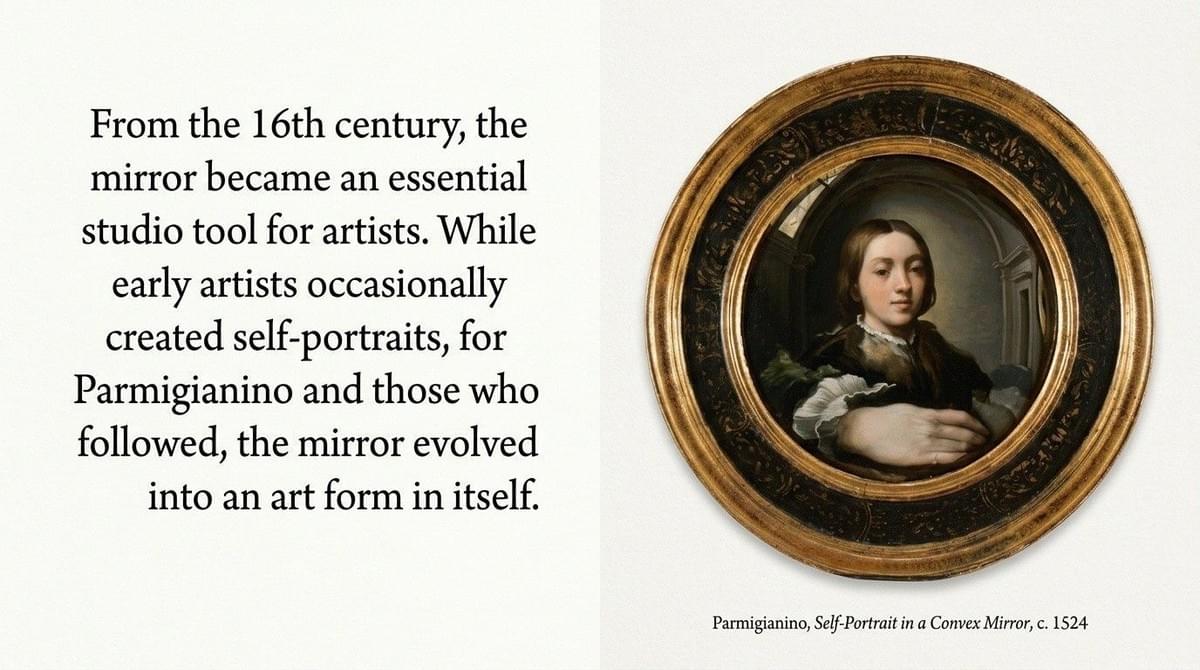
- Observation and Self-Portraiture: Artists like Leonardo da Vinci advocated using mirrors to achieve objective judgments of their work and to develop unique methods of self-representation. This led to pioneering works such as **Parmigianino’s Self-Portrait in a Convex Mirror (1524), where the artist’s youthful face is rendered with an unsettling, almost distorted clarity, inviting contemplation on the nature of perception and artistic illusion.
- Symbolic Depth: In Jan van Eyck’s Arnolfini Portrait (1434), a convex mirror in the background reflects the entire room, including figures entering through the doorway, often interpreted as the artist himself. This detail serves not only as a mark of authenticity but also as a symbolic representation of spiritual presence and the expanded narrative space of the painting.
Baroque Play and Modern Perplexity
By the Baroque era, mirrors became sophisticated instruments for optical play and dramatic effect. Diego Velázquez’s masterpiece Las Meninas (1656), for example, features a mirror reflecting the King and Queen of Spain—their presence an elusive and ambiguous element that blurs the boundaries between painting, viewer, and reflected reality.
In the 19th century, **Édouard Manet’s A Bar at the Folies-Bergère (1882) uses a large mirror to create a complex and unsettling illusion. The reflection of the barmaid appears distorted and misaligned with her actual position, challenging conventional perspective and creating a psychological distance. This visual paradox sparked enduring debate, subtly questioning the objective truth of visual perception and the fragmented nature of modern experience.
Contemporary Reflections: Kapoor’s Sky Mirror
In the 20th and 21st centuries, artists continue to harness the power of mirrors to explore perception, identity, and the environment. Caravaggio, though not explicitly a "mirror painter," masterfully used reflections in objects and surfaces to heighten the realism and dramatic intensity of his scenes.
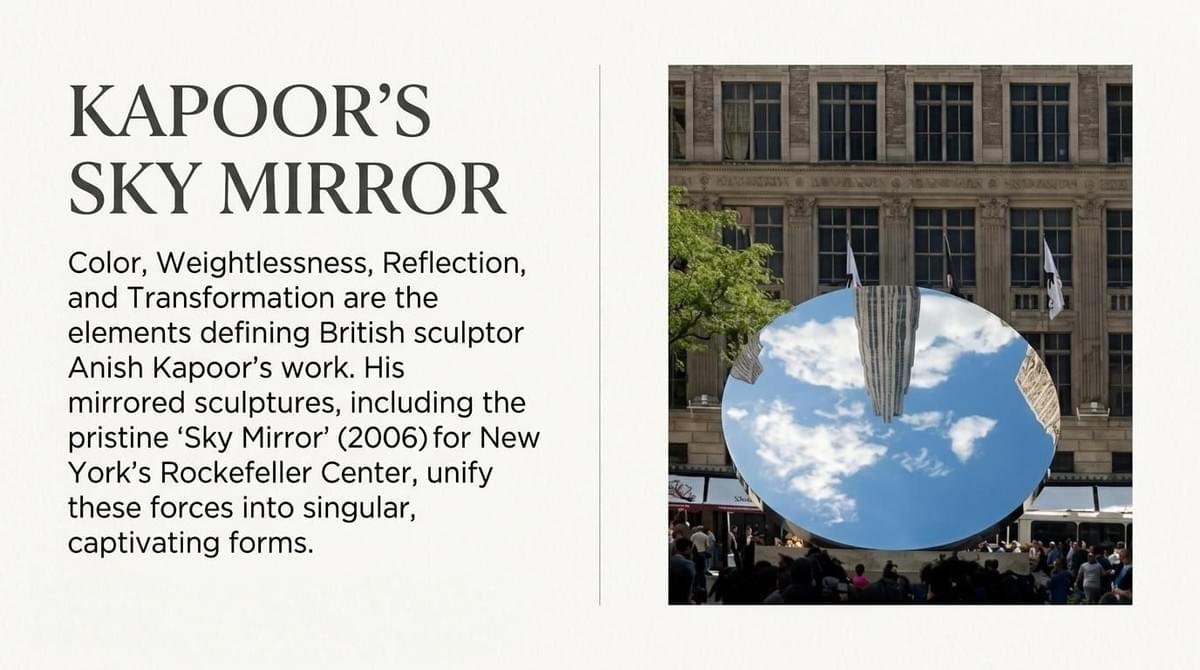
British sculptor Anish Kapoor has elevated the mirrored surface into monumental, immersive installations. His Sky Mirror series, exemplified by the pristine, concave Sky Mirror (2006) at New York’s Rockefeller Center, transforms the surrounding architecture and sky into a dynamic, inverted tableau. These works, often made of highly polished stainless steel, are not merely reflective objects; they are portals that unify color, weightlessness, and transformation, inviting viewers to experience a new, captivating relationship between themselves, the artwork, and their environment.