Linear perspective is a mathematical system for projecting three-dimensional space onto a flat, two-dimensional surface. Formulated by Italian Renaissance architects and painters in the early 15th century, it revolutionized Western visual culture—and remains the foundation of architectural rendering, cinema, and 3D computer graphics today.
Brunelleschi’s Peephole and Alberti’s De Pictura
For millennia, artists across cultures grappled with how to represent spatial depth on a flat plane. Classical Greek and Roman painters observed empirically that distant objects appear smaller than near ones and that receding parallel lines seem to converge, while medieval European and traditional East Asian painters often favored overlapping planes or parallel isometric projection to suggest depth.
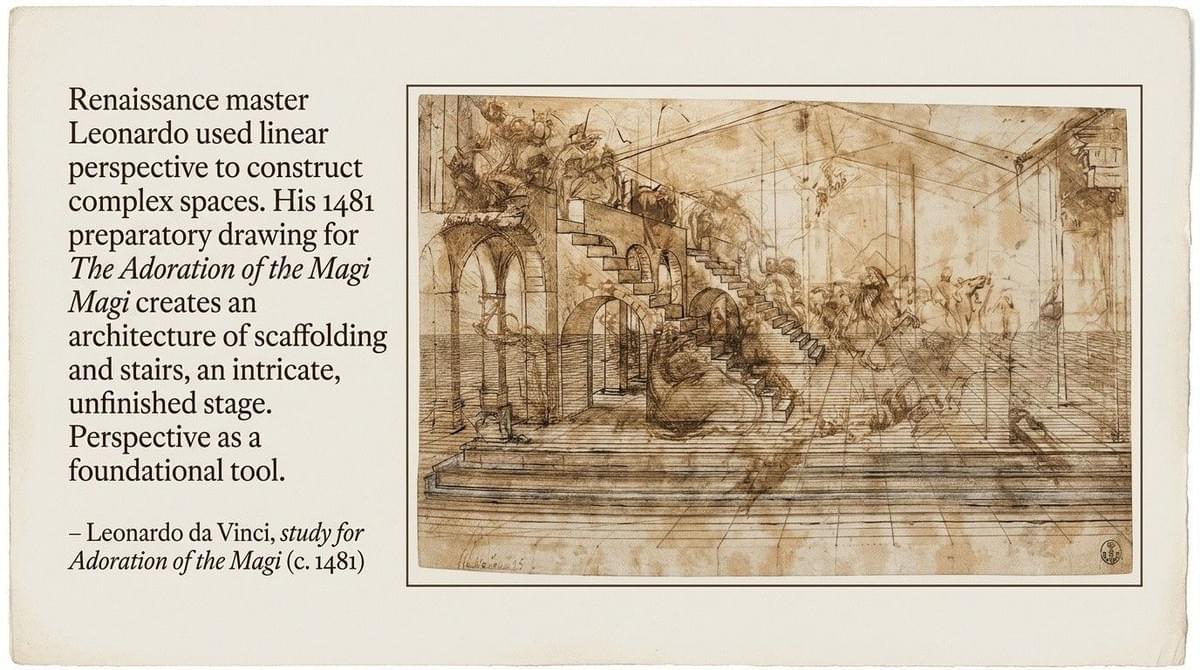
True scientific perspective crystallized in early 15th-century Florence. Around 1415–1420, the architect Filippo Brunelleschi demonstrated the geometry of a single vanishing point in a famous optical experiment before the Florence Baptistery. Painting an exact view of the Baptistery onto a small wooden panel, Brunelleschi drilled a tiny peephole directly through the painting’s vanishing point. Looking from the back of the panel through the hole into a mirror held at arm’s length, viewers saw the painted reflection merge seamlessly with the real building around it. In 1435, humanist Leon Battista Alberti codified Brunelleschi’s discovery in his treatise On Painting (De pictura), showing artists how to construct a coherent spatial grid (orthogonals) receding toward a central vanishing point on the horizon line.
Florentine Sacred Space and The Ideal City
By combining precise geometric measurement with optical illusion, linear perspective anchors the viewer at a specific vantage point in front of the image: as a row of columns or trees recedes toward the horizon, each interval diminishes proportionally in scale.
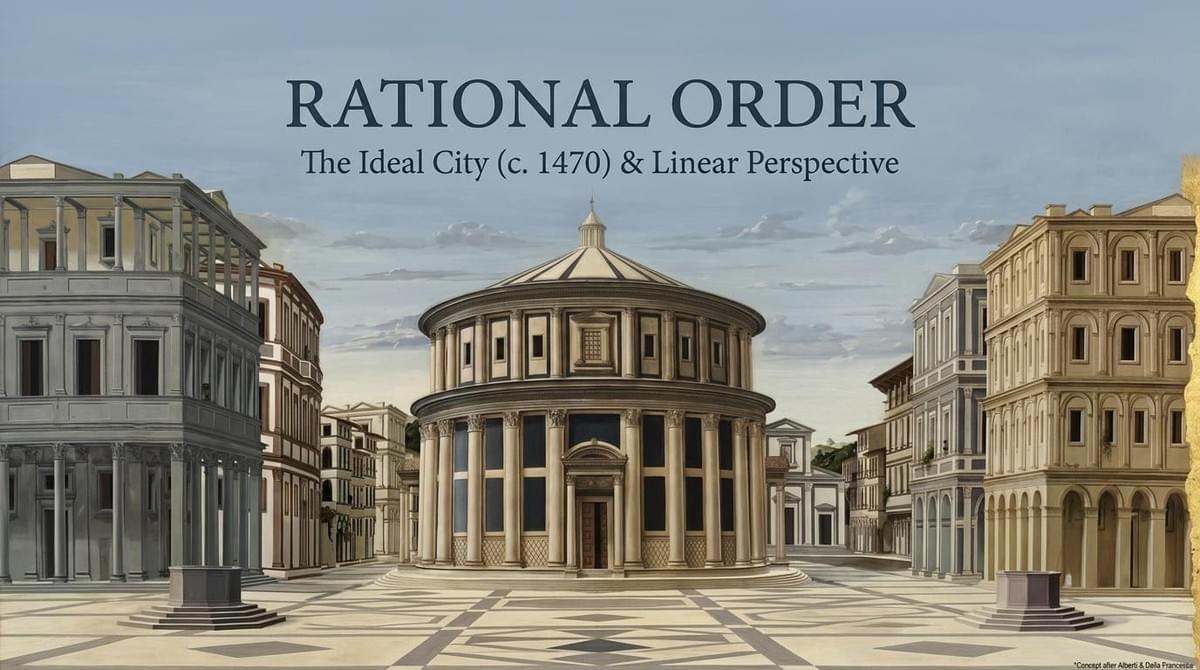
In prosperous 15th-century Florence, where merchant-bankers funded grand civic and ecclesiastical projects, this rational spatial order transformed art. Building on the stage-like architectural boxes pioneered a century earlier by Giotto, artists such as Donatello, Lorenzo Ghiberti, and Masaccio integrated human figures into measured architectural settings. In Masaccio’s groundbreaking fresco The Holy Trinity (c. 1425–1427, Santa Maria Novella), a barrel-vaulted chapel seems to carve straight through the solid church wall, calibrated to the eye level of a viewer standing on the nave floor. By the late 15th century, works such as the celebrated Urbino panel The Ideal City (c. 1470–1480s) elevated linear perspective into an emblem of humanist utopia—presenting a harmonious piazza where every colonnade and paving stone converges at the exact center of the panel.
From Dutch Interiors to Metaphysical Unease
While single-point perspective excelled at framing architectural symmetry, Renaissance masters like Leonardo da Vinci noted that rigid geometric lines alone could not capture the hazy depth of open landscapes (which required atmospheric perspective). From the 17th to the 19th century, linear perspective remained a cornerstone of academic training. In 17th-century Delft, Dutch masters Pieter de Hooch and Johannes Vermeer used tiled floors, open doorways, and receding window frames to construct hushed domestic interiors bathed in tranquil light.
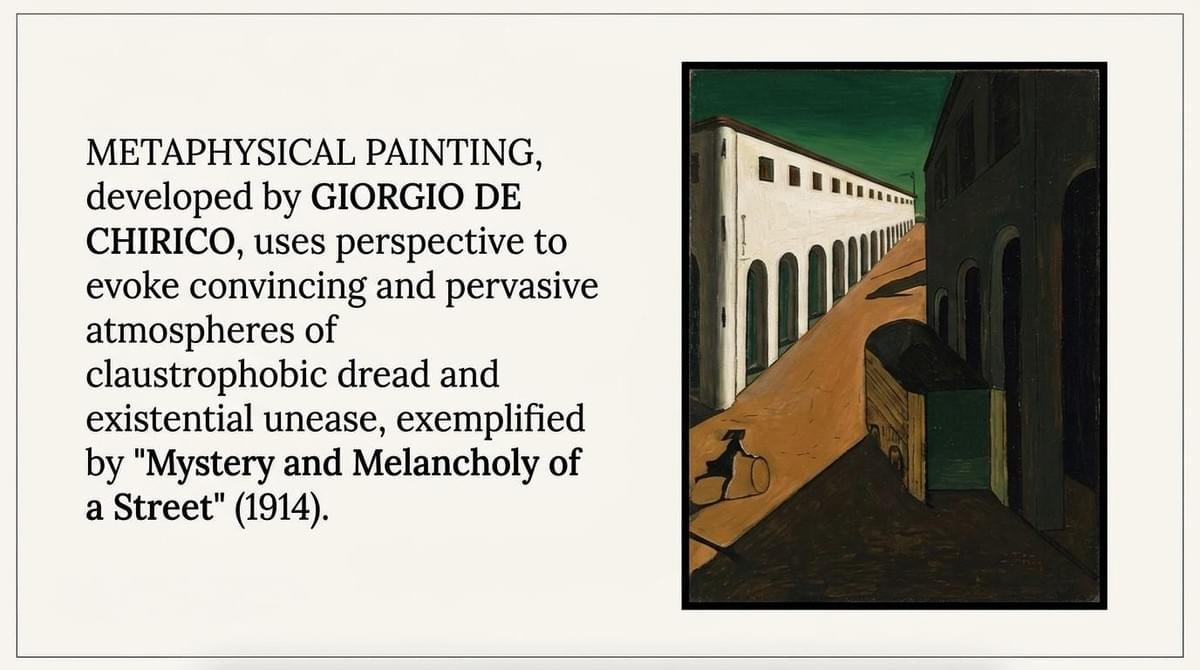
In the early 20th century, however, modern pioneers turned Renaissance perspective against itself. In his Metaphysical Painting (Pittura Metafisica), Italian artist Giorgio de Chirico—followed later by Surrealist René Magritte—manipulated and subverted Brunelleschi’s laws. By setting steep, conflicting vanishing points inside eerie, sunlit piazzas, De Chirico transformed the Renaissance geometry of rational order into a stage of vertigo, mystery, and existential dread.