Beginning in the 5th century BCE, ancient Greek sculptors unlocked a deceptively simple secret for making stone and bronze feel alive. Known since the Renaissance by the Italian term contrapposto ("counterpose"), this approach broke away from the stiff, pillar-like symmetry of earlier archaic statues—creating figures that appear simultaneously at rest and on the verge of motion.
Polykleitos and the Doryphoros: Art as Law
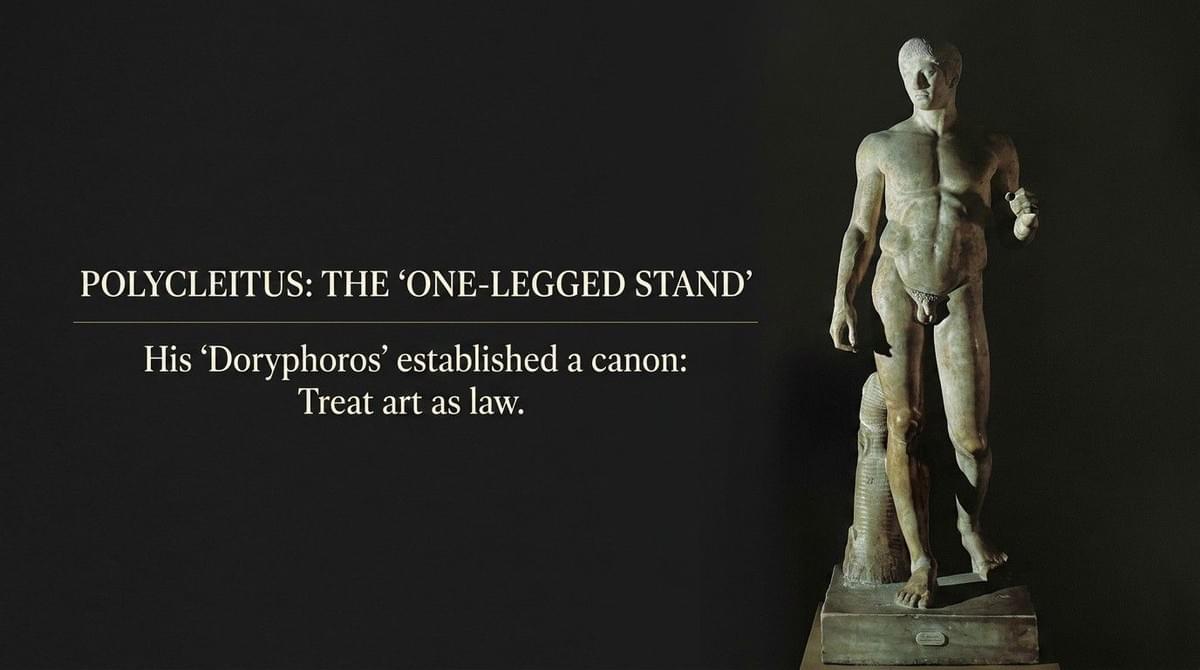
At the heart of contrapposto is a relaxed, asymmetrical balance between tension and release. Nowhere is this shift clearer than in the Doryphoros (Spear-Bearer, c. 450–440 BCE) by the Greek master Polykleitos (also spelled Polycleitus).
Although Polykleitos’s original bronze statue is lost, it survives through ancient Roman marble copies—most famously the example unearthed in Pompeii and now housed in the National Archaeological Museum of Naples. Rather than standing with weight planted equally on both feet, the Doryphoros shifts his weight onto his right leg, leaving the left leg bent and relaxed, poised as if mid-stride. This single shift ripples up through the entire anatomy: the right hip rises while the left shoulder drops, creating a subtle, S-curved twist through the torso that balances active and resting muscles in effortless harmony.
Polykleitos paired this statue with a theoretical treatise titled the Canon ("Rule" or "Measure"), which laid out mathematical proportions for the ideal human body. Though the treatise itself survives only in brief ancient quotations, the Roman author Pliny the Elder noted that generations of sculptors studied the Doryphoros and followed Polykleitos’s Canon "as if it were a law."
From Renaissance Revival to Contemporary Performance
Adopted by ancient Roman sculptors and theorists, contrapposto lay largely dormant during the Middle Ages before roaring back to life in 15th-century Florence. Renaissance masters from Donatello to Michelangelo embraced this classical counterpose to liberate statues from architectural columns, culminating in the coiled tension of Michelangelo’s David. By the 19th century, contrapposto had become the universal grammar of academic figurative sculpture around the world.
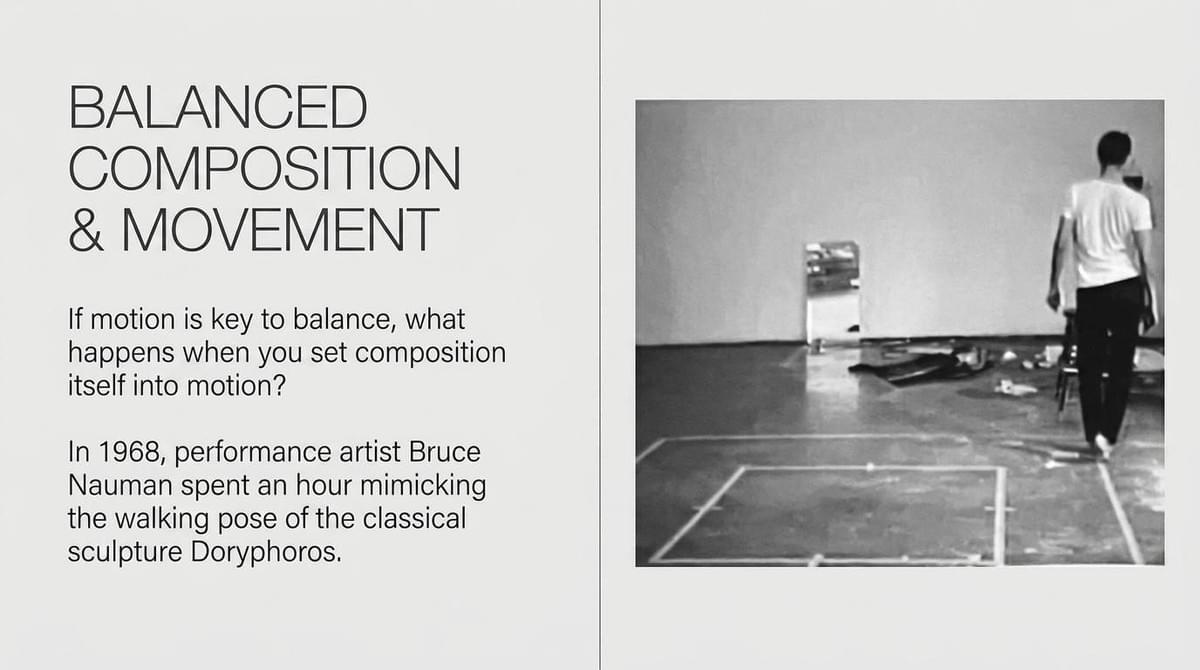
Yet what happens when this static formula for "implied motion" is set into actual motion? In the late 1960s, American conceptual artist Bruce Nauman turned classical poise into grueling physical performance. In his landmark films Walking in an Exaggerated Manner Around the Perimeter of a Square (1967–1968) and Walk with Contrapposto (1968), Nauman spent an hour pacing back and forth inside his studio, throwing his hips and shoulders into extreme, theatrical counterpose with every step—turning a 2,400-year-old sculptural ideal into raw, living satire.