Built from thousands—or even millions—of tiny cubes of cut stone, colored glass, mother-of-pearl, and shell known as tesserae, a mosaic transforms humble fragments into a shimmering, unified vision. Closely tied to architectural floors, walls, and vaults, this ancient medium combines physical durability with monumental visual drama.
From Ancient Mesopotamia to Pompeii’s Alexander Mosaic
The art of mosaic began in Mesopotamia as early as the 4th and 3rd millennia BCE, when Sumerian builders pressed ribuan painted clay cones into temple walls to create protective geometric patterns. By the 4th century BCE, artisans in ancient Greece were crafting expressive floor mosaics from natural black, white, and red pebbles—a tradition that Roman mosaicists soon refined by cutting stone and colored glass into tiny, uniform cubes (tesserae) capable of rivaling the subtlest brushstrokes of painting.
Combining everyday durability with breathtaking luxury, Roman mosaics adorned everything from public bathhouses to aristocratic villas. The grandest surviving Hellenistic-Roman pavement—the famous Alexander Mosaic (c. 100 BCE, based on a 4th-century BCE Greek painting), excavated from the House of the Faun in Pompeii—comprises roughly 1.5 million tiny stone and glass tesserae. Depicting the clash between Alexander the Great and Persian king Darius III at the Battle of Issus, the work captures the chaos of war on a scale as epic as the historic battle itself.
The Byzantine Empire: Lifting Gold and Light Toward Heaven
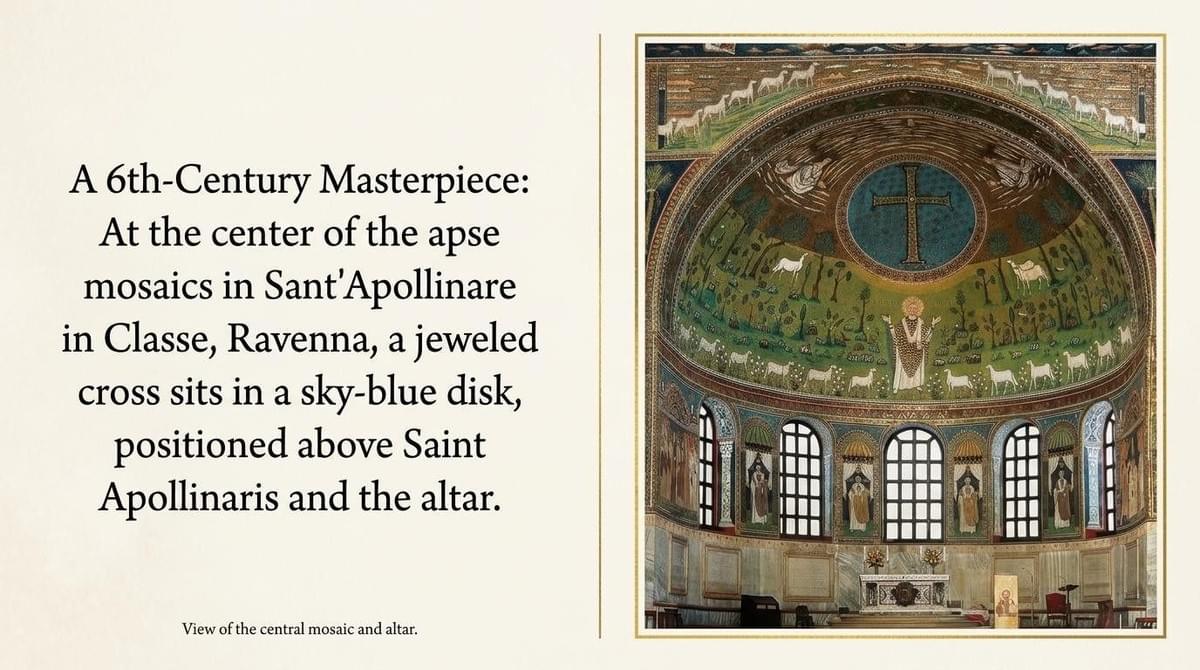
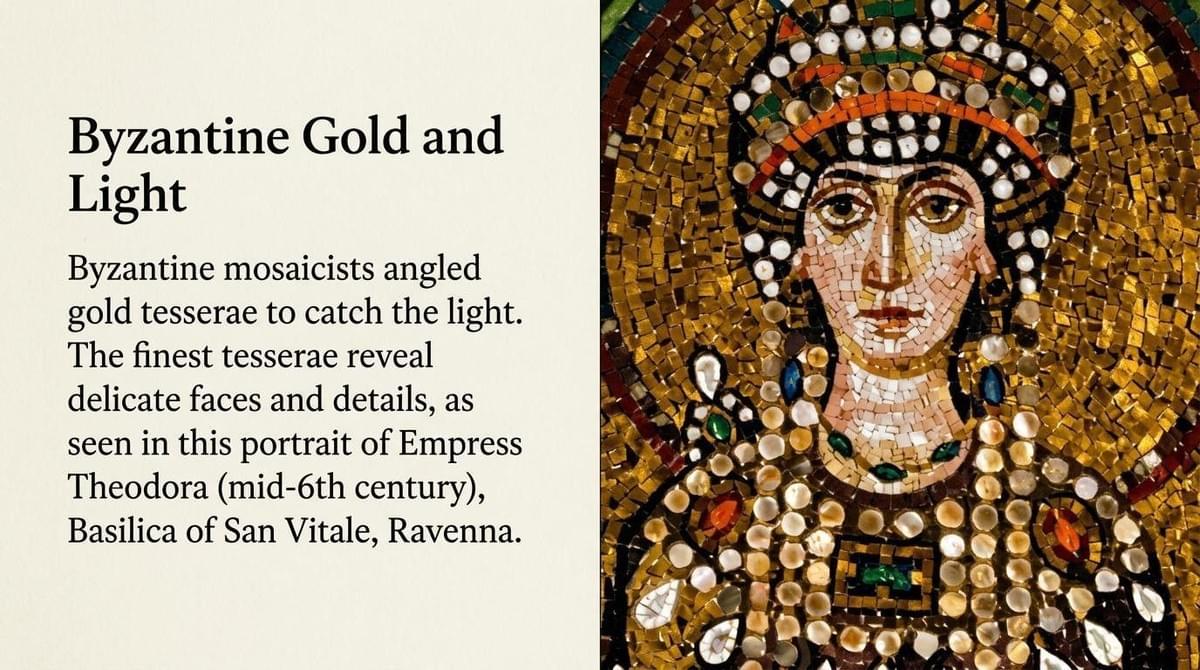
Between the 5th and 14th centuries, Byzantine artists revolutionized the medium by lifting mosaic from the Roman floor onto the soaring walls, apses, and domes of Christian churches. Beginning in the 5th and 6th centuries—most famously in Ravenna and Constantinople—mosaicists perfected glass tesserae fused with thin gold and silver leaf (smalti). Rather than laying these cubes flat, craftsmen set them into the wall at slight, varied angles so that flickering candlelight and shifting sunbeams would bounce off the surface—dissolving heavy stone architecture into a radiant, otherworldly realm of spirit.
Byzantine Craftsmanship and Early Islamic Splendor
Byzantine mosaic masters worked much like fresco painters. After sketching the composition onto a base coat of mortar, they applied only as much fine wet plaster as could be completed in a single day’s work (a giornata—often less than a square meter for intricate figures) before pressing each tessera into place by hand. In medieval Byzantium, there was no hierarchy dividing "fine art" from "craft": the spiritual and aesthetic perfection of the shimmering wall was paramount.
From the 7th to the 11th centuries, early Islamic architecture likewise embraced the brilliance of gold-ground glass mosaic—often employing Byzantine-trained masters.Strictly avoiding human and animal figures in sacred spaces, monumental Islamic mosaics—such as those adorning the Dome of the Rock in Jerusalem (691–692 CE) and the Great Mosque of Damascus (c. 715 CE)—transformed Quranic calligraphy, stylized trees, and jeweled floral motifs into visions of paradise.
Modern Mosaic: Gaudí’s Trencadís and 20th-Century Reinvention
In the modern era, visionary architects and painters bridged the old divide between studio designer and mosaic artisan:
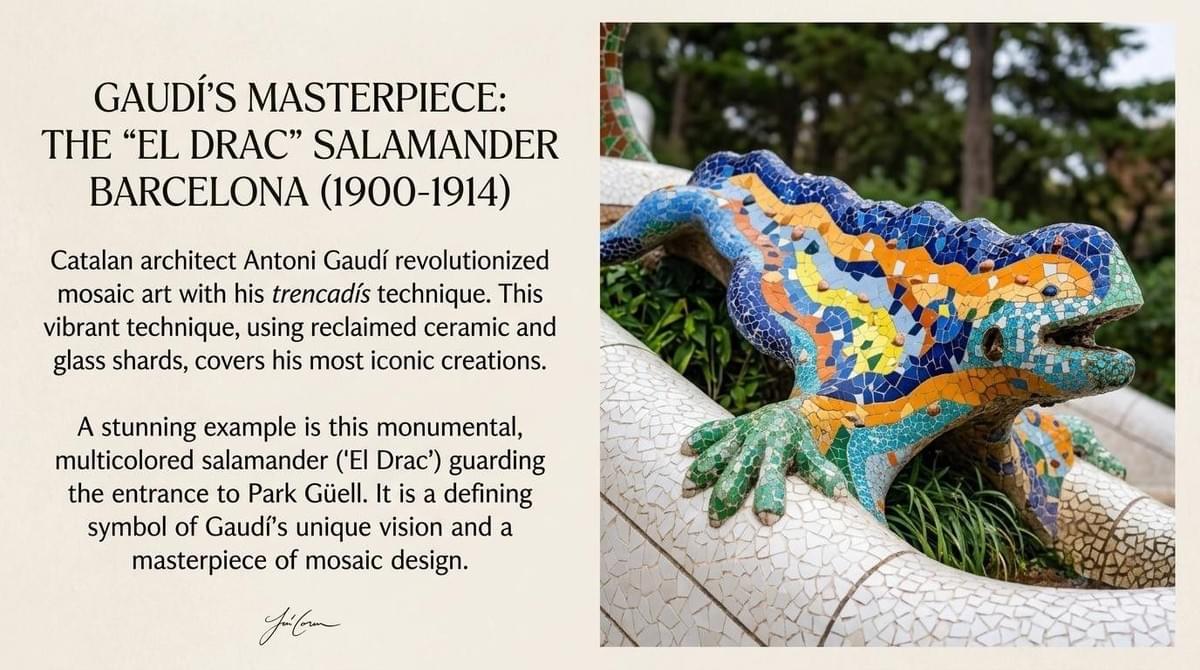
- Catalan Modernisme: In Barcelona, architect Antoni Gaudí (1852–1926) reinvented mosaic through trencadís (pique-assiette)—sheathing the undulating benches and sculptures of Park Güell (1900–1914) in vibrant shards of broken ceramic tiles, plates, and glass.
- Mid-20th-Century Revival: Around mid-century, artists from Russian-born mosaicist Boris Anrep (who completed his celebrated floor mosaics at London’s National Gallery in 1952) to modern masters like Henri Matisse, Marc Chagall, and Fernand Léger brought expressive modern color and bold abstraction back to architectural walls, proving that an ancient art of fragments could speak with fresh contemporary energy.